
Best Car Audio DSP Processors (Tested) – 2026 Buyer's Guide
I walk through my top car audio DSP processor picks by category — flagship SQ, best all-around, best with Dirac Live auto-tuning, best OEM integration, best DSP/amp combo, best mid-range, and best budget — then help you understand what to look for and how to get the most out of your DSP.

A DSP is the single biggest upgrade you can make
A digital signal processor lets you correct your car's unique acoustic environment, integrate factory systems seamlessly, and unlock the true potential of your speakers and amplifier. Whether you're running a factory head unit or a high-end aftermarket source, a DSP is the tool that transforms good car audio into truly exceptional sound. I've organized the picks below by use case — from flagship SQ-competition systems to budget options that deliver real processing power at entry-level prices.
Do I actually need a DSP?
Not every system needs one — but most do. Running a factory head unit with aftermarket speakers? A DSP with high-level inputs is essential to retain steering-wheel controls and integrate your components. Building a serious install with multiple amps and subs? A DSP is non-negotiable for time alignment, crossovers, and room correction. Even entry-level builds benefit from crossover and time-alignment control most head units lack. The only time you might skip it is a simple 2-way system with no subwoofer — and even then, a modest DSP opens up bass management and room correction that make a real difference. To match your DSP with the right amplification, see my best car amplifiers guide and my guide to choosing the right amplifier.
Why I built this guide
A DSP is the difference between a system that’s loud and a system that sounds right. It’s the box that fixes the factory EQ curve, time-aligns the speakers so the stage sits in front of you instead of down in the door, and lets you actually dial the sound in — the step most people skip and then wonder why their expensive speakers sound flat.
I sorted my DSP picks by category — flagship SQ, best all-around, Dirac auto-tuning, OEM integration, DSP/amp combos and budget — ranked below.
Compare my 7 DSP picks side by side
| Best for ↕ | My pick ↕ | Channels In/Out ↕ | Bit Depth / Sample Rate ↕ | Rating ↕ | Buy |
|---|---|---|---|---|---|
| Best Flagship SQ | 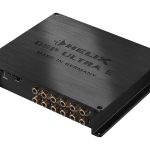 Helix DSP Ultra S Helix DSP Ultra S | 8 in / 12 out (+ 8 virtual) | 32-bit / 96kHz | View pick → | |
| Best All-Around | 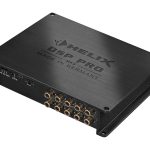 Helix DSP Pro Mk3 Helix DSP Pro Mk3 | 8 in / 10 out (+ virtual) | 32-bit / 96kHz | View pick → | |
| Best Auto-Tuning | 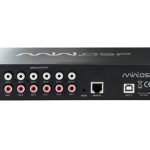 miniDSP C-DSP 8×12 DL miniDSP C-DSP 8×12 DL | 8 in / 12 out | 32-bit / 96kHz | View pick → | |
| Best OEM Integration | 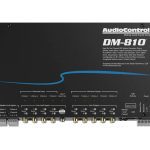 AudioControl DM-810 AudioControl DM-810 | 8 in / 10 out | 24-bit / 48kHz | Buy Now $699.00 on Amazon | |
| Best DSP + Amp Combo |  Alpine PXE-C80-88 OPTIM8 Alpine PXE-C80-88 OPTIM8 | 8 in / 8 out | 24-bit / 96kHz | Buy Now $999.95 on Amazon | |
| Best Mid-Range |  Helix DSP.3S Helix DSP.3S | 8 in / 8 out (+ virtual) | 24-bit / 96kHz | View pick → | |
| Best Budget |  Dayton Audio DSP-408 Dayton Audio DSP-408 | 4 in / 8 out | 24-bit / 48kHz | Buy Now $199.98 on Amazon |
CarAudioNow may earn a commission from retailer links. Brands do not influence the recommendations.
How we test & choose car audio DSP processors
I install and tune each DSP in real cars, then judge the audio signal path, the tuning software, I/O flexibility, OEM integration, and real-world value across budget, mid-range and flagship tiers.
I install and tune each DSP in real cars and measure the tuning software's learning curve — the same methodology I use in my amplifier-tuning guide and my own Ford F-150 build.
I evaluate the audio signal path — 24-bit vs 32-bit processing, sample rates up to 96kHz, converter quality (AKM vs Burr-Brown), and THD+N measurements.
PC tool, mobile app, learning curve, measurement features, and ease of configuration.
High-level inputs for OEM integration, RCA and digital inputs, channel count, virtual channels, and expansion options.
Signal summing, de-equalization, factory-system retention, and compatibility with factory head units.
Real-world street pricing and performance per dollar across budget, mid-range, and flagship tiers.
Questions that decide your pick
- Factory head unit or full aftermarket source? Keeping the factory radio means you need high-level inputs and signal summing (AudioControl DM-810, or a Helix with high-level inputs) to retain steering-wheel controls. A full aftermarket source gives you more input flexibility.
- Manual tuning or auto-tuning? PC-based manual tuning (Helix) gives maximum control with a learning curve; measurement-based auto-tuning (miniDSP + Dirac Live) gets you most of the way with a mic and an algorithm.
- Standalone DSP or a DSP + amp combo? A combo like the Alpine OPTIM8 saves space and wiring for modest systems; a standalone DSP plus separate amps scales to higher power and complexity.
- How many channels do you need? Count your active speaker zones plus subs. 8 outputs cover most 3-way + sub builds; 10–12 outputs (Pro MK3 / Ultra S) handle complex active systems.
- How much should you spend? Budget ~5–10% of your total audio spend on the DSP and match its tier to your amps and speakers. ~$200 (Dayton DSP-408) transforms an entry build; $1,000+ (Ultra S) suits SQ competition.
My top 7 car audio DSP processors — 2026 reviews
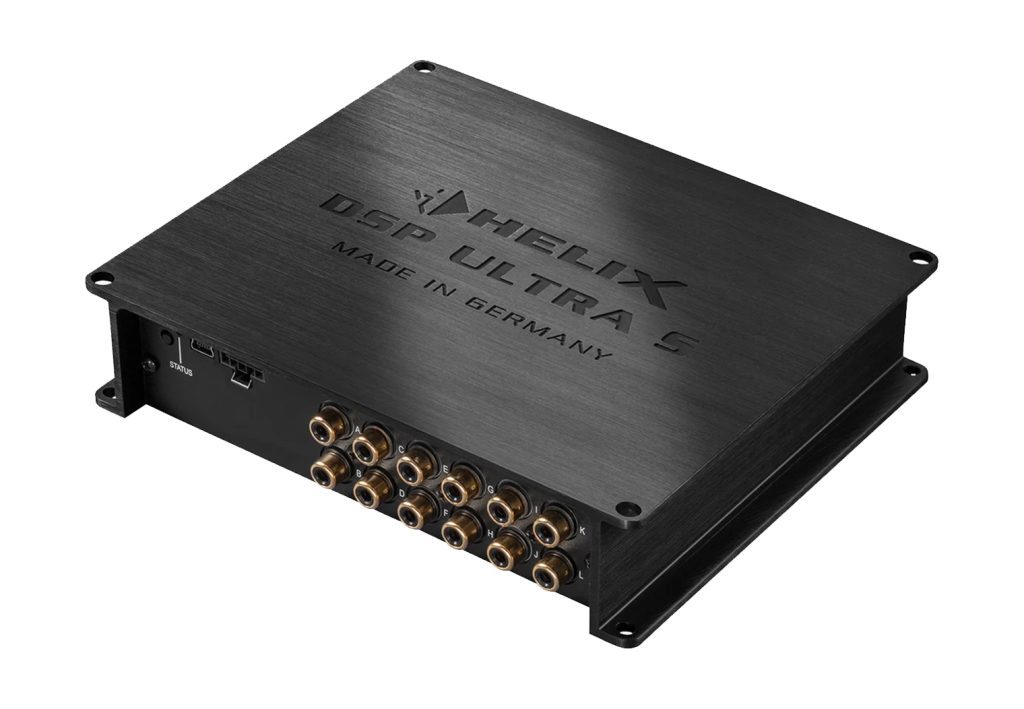
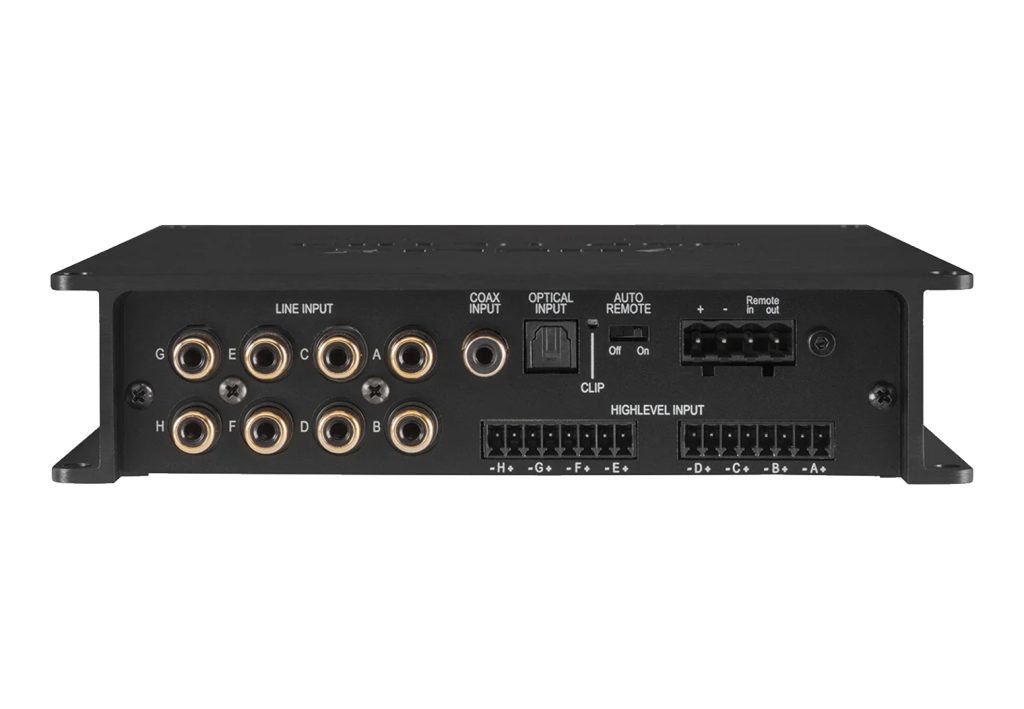
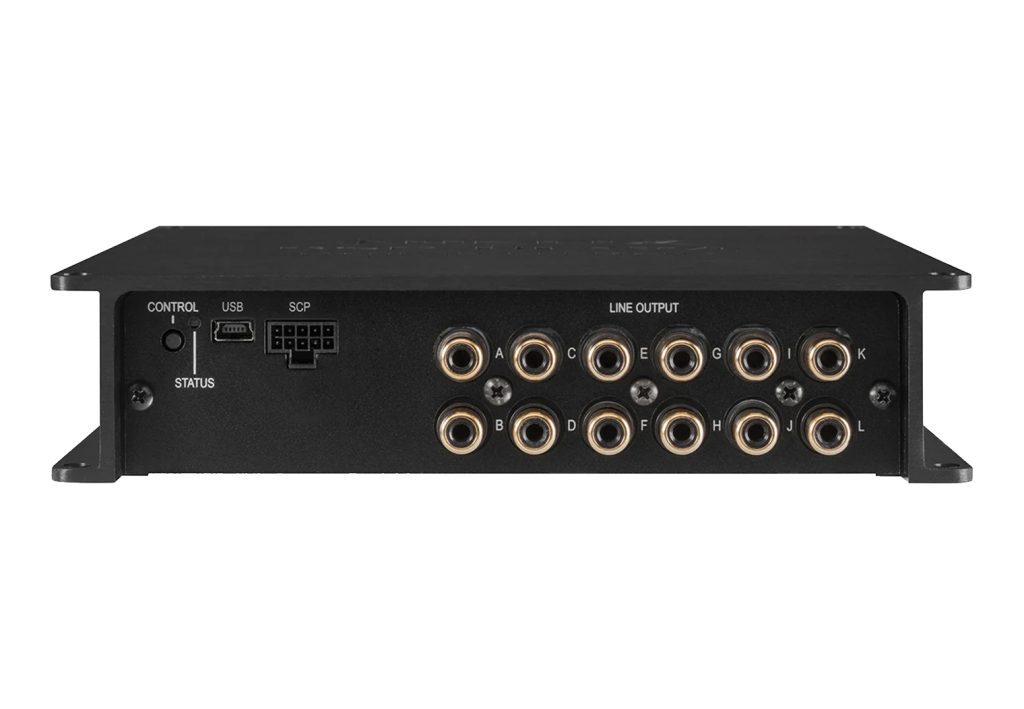
Helix DSP Ultra S
The reference standard for SQ competition
CarAudioNow may earn a commission from retailer links. Brands do not influence the recommendations.
Why I picked it
The Helix DSP Ultra S is the reference standard for sound quality competition builds and serious enthusiasts who demand the absolute best car audio DSP processor money can buy. Dual 32-bit AKM Velvet Sound converters, a 400MHz SHARC processor, full 96kHz/32-bit signal path, 8 inputs with 12 outputs plus 8 virtual channels — this processor is built to handle the most complex active system topologies and deliver reference-grade audio fidelity. The PC-Tool tuning software is powerful enough for competition-grade setups, but expect a learning curve if you're new to DSP.
Bottom line: If you're serious about sound quality and have the budget, the Ultra S is the best car audio DSP processor for uncompromising fidelity — the choice of competition installers and SQ enthusiasts who refuse to compromise. Pair it with a quality amplifier from my best car amplifiers guide to unlock its full potential.
| Make | Helix |
| Model | DSP Ultra S |
| Channels In/Out | 8 in / 12 out (+ 8 virtual) |
| Processor | SHARC 400MHz |
| Bit Depth / Sample Rate | 32-bit / 96kHz |
| THD+N | -106 dB |
| S/N Ratio | >110 dB |
| Inputs | 8x RCA (high/low), HEC slot |
| Outputs | 12x RCA + 8x virtual via ACO |
| EQ Bands | 31-band parametric per channel |
| Time Alignment | ±500mm, fractional-mm precision |
| Dimensions | 7.1″ W x 5.1″ H x 2.6″ D |
Reasons to buy
- Reference-grade 96kHz/32-bit audio path with AKM Velvet Sound converters
- 12 output channels + 8 virtual channels for extremely complex active systems
- HEC expansion slot for Bluetooth HD, USB streaming, and future add-ons
- SHARC processor handles advanced tuning algorithms and multi-band compression
- Proven track record in sound quality competitions
Reasons not to buy
- Premium price (~$1,200–1,500 street)
- Requires PC with DSP PC-Tool for full tuning — no mobile app
- Steep learning curve for beginners; competition-focused feature set
- Overkill for casual car audio upgrades
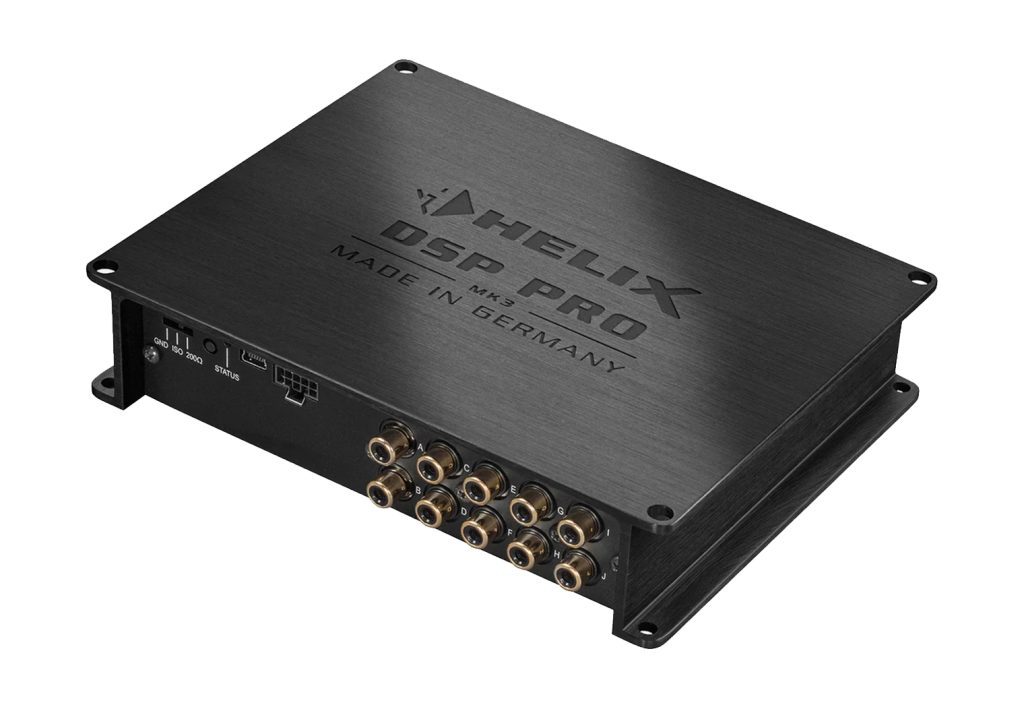
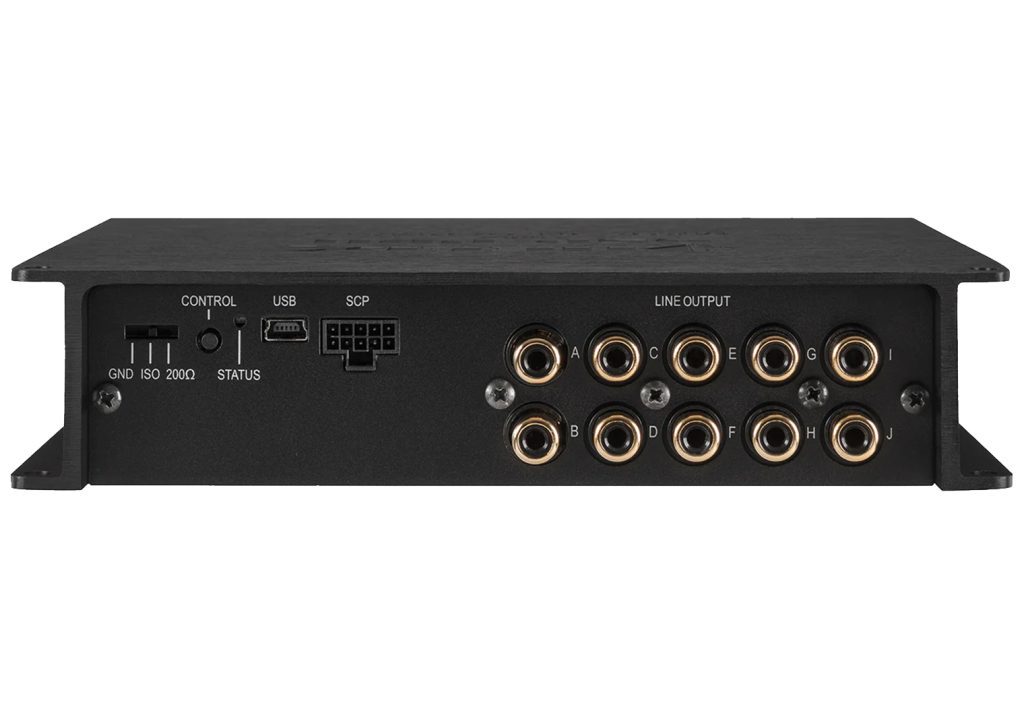
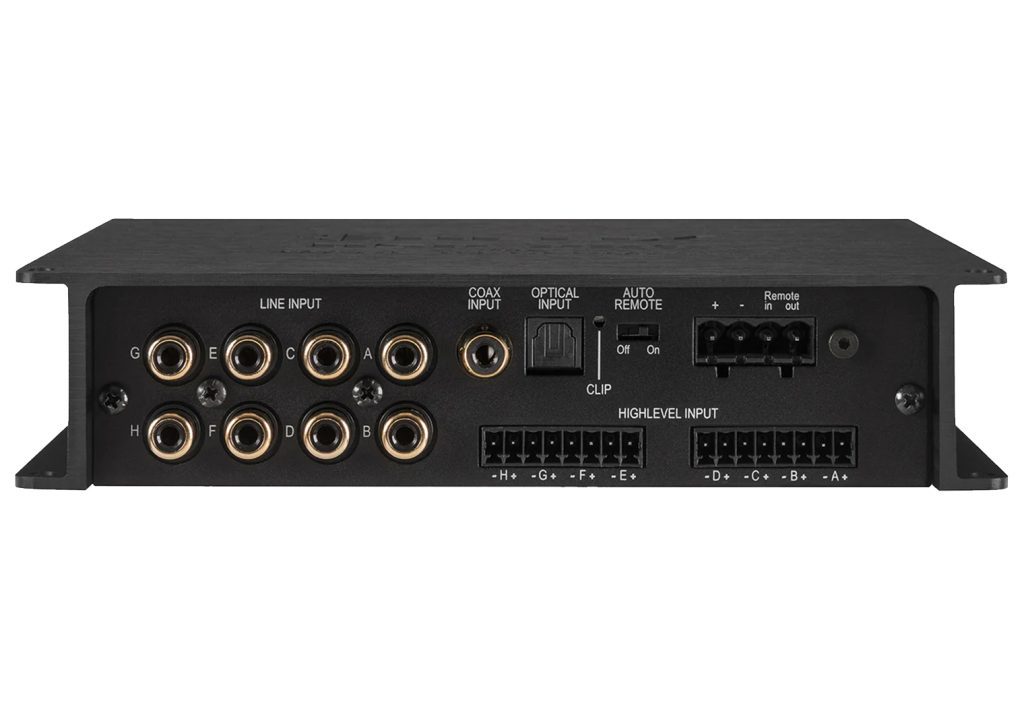
Helix DSP Pro Mk3
Ultra S performance at a saner price
CarAudioNow may earn a commission from retailer links. Brands do not influence the recommendations.
Why I picked it
The Helix DSP Pro MK3 is the sweet spot of the Helix lineup and my pick for the best all-around car audio DSP processor for serious builds. It shares the same TwinDSP architecture and processing power as the Ultra S, but with 10 output channels instead of 12, and it costs significantly less. The revised high-level inputs handle factory systems up to 32V without issue. For 90% of custom builds — even competition-level installs — the Pro MK3 delivers everything the Ultra S offers, at a price that makes sense for most enthusiasts.
Bottom line: The Pro MK3 is the best car audio DSP processor for the money if you want serious sound quality without the Ultra S premium — my top recommendation for most enthusiasts and serious installations. Pair it with amplifiers that match your system using my 5-channel vs separate amps guide.
| Make | Helix |
| Model | DSP Pro MK3 |
| Channels In/Out | 8 in / 10 out (+ virtual) |
| Processor | SHARC 400MHz |
| Bit Depth / Sample Rate | 32-bit / 96kHz |
| THD+N | -104 dB |
| S/N Ratio | >108 dB |
| Inputs | 8x RCA (high/low), HEC slot |
| Outputs | 10x RCA + virtual via ACO |
| EQ Bands | 31-band parametric per channel |
| Time Alignment | ±500mm, fractional-mm precision |
| Dimensions | 7.1″ W x 5.1″ H x 2.6″ D |
Reasons to buy
- TwinDSP architecture with 2.4 billion MAC operations per second
- 10 outputs + virtual channels via ACO platform
- High-level inputs rated to 32V for any factory system integration
- Excellent value vs Ultra S — does 90% of the job at 70% of the price
- Same HEC expansion slot for Bluetooth and USB
Reasons not to buy
- Still requires PC for tuning (no mobile app)
- Price point (~$900–1,100) may be steep for casual upgrades
- Smaller feature set than Ultra S for extreme competition builds
- Fewer physical outputs than Ultra S (10 vs 12)
miniDSP C-DSP 8×12 DL
Dirac Live auto-tuning, measured precision
CarAudioNow may earn a commission from retailer links. Brands do not influence the recommendations.
Why I picked it
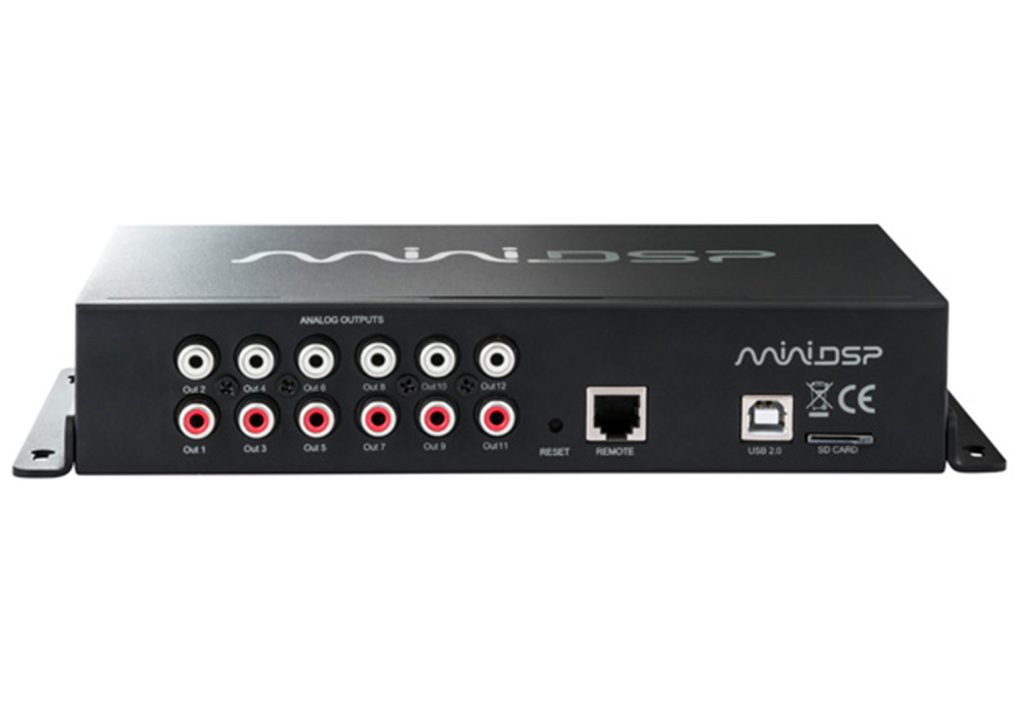
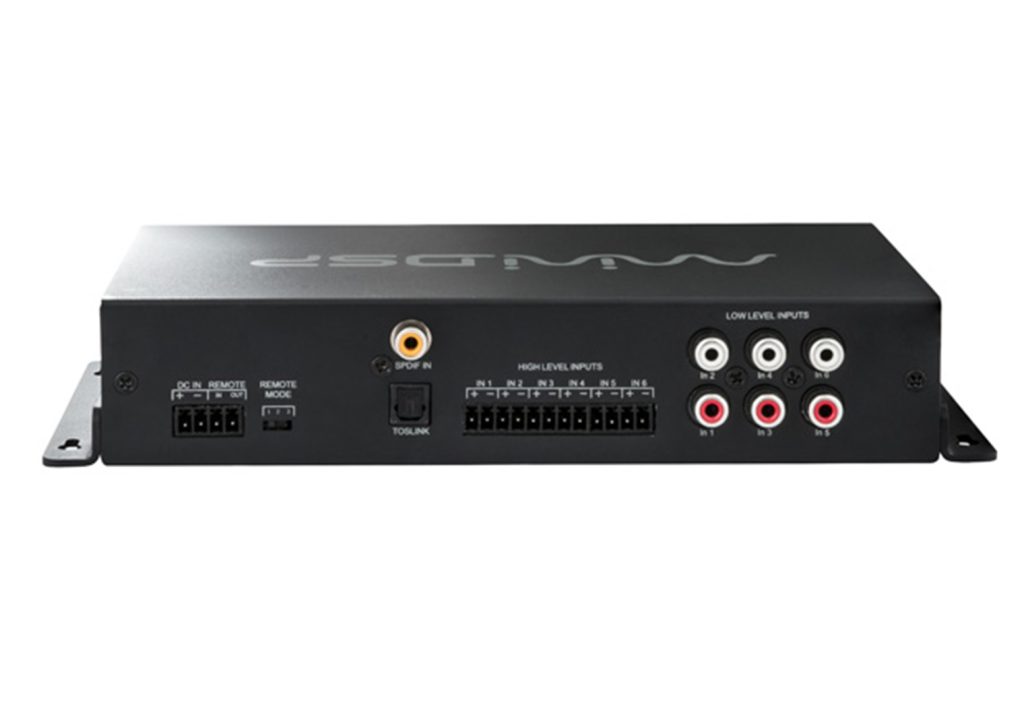
The miniDSP C-DSP 8×12 DL is the first aftermarket car audio DSP processor to integrate Dirac Live room correction — and it works remarkably well. The core is a 400MHz SHARC with 32-bit AKM converters, 8 inputs, and 12 outputs. The magic is Dirac Live: you place a measurement microphone in the car, run Dirac's algorithm, and the software calculates precise corrections for your car's acoustics — measurably superior room correction that rivals manual tuning. Plan for ~$899 base plus ~$400 for the Dirac Live license, but if auto-tuning appeals to you the results justify it.
Bottom line: If you prefer measurement-based tuning over manual adjustment, the C-DSP 8×12 DL with Dirac Live is the best car audio DSP processor with auto-tuning. High-quality converters plus algorithmic correction make it a compelling choice for installers and enthusiasts who value precision.
| Make | miniDSP |
| Model | C-DSP 8×12 DL |
| Channels In/Out | 8 in / 12 out |
| Processor | SHARC 400MHz |
| Bit Depth / Sample Rate | 32-bit / 96kHz |
| THD+N | -107 dB |
| S/N Ratio | >110 dB |
| Inputs | 8x RCA (high/low) |
| Outputs | 12x RCA |
| EQ Bands | Parametric + Dirac Live |
| Time Alignment | ±500mm, 1mm resolution |
| Dimensions | 7.3″ W x 5.2″ H x 2.4″ D |
Reasons to buy
- Dirac Live auto-tuning produces measurably superior room correction
- 32-bit AKM converters with -107 dB THD+N specification
- 12 outputs with full parametric EQ and crossovers up to 48 dB/octave
- Measurement-based approach removes guesswork from tuning
- Works with high-level or RCA inputs for any system
Reasons not to buy
- Dirac Live license adds ~$400 on top of the base price
- Tuning software has a learning curve despite “auto” correction
- Limited dealer/installer network compared to Helix or AudioControl
- Requires Windows PC for Dirac Live — not mobile-app friendly
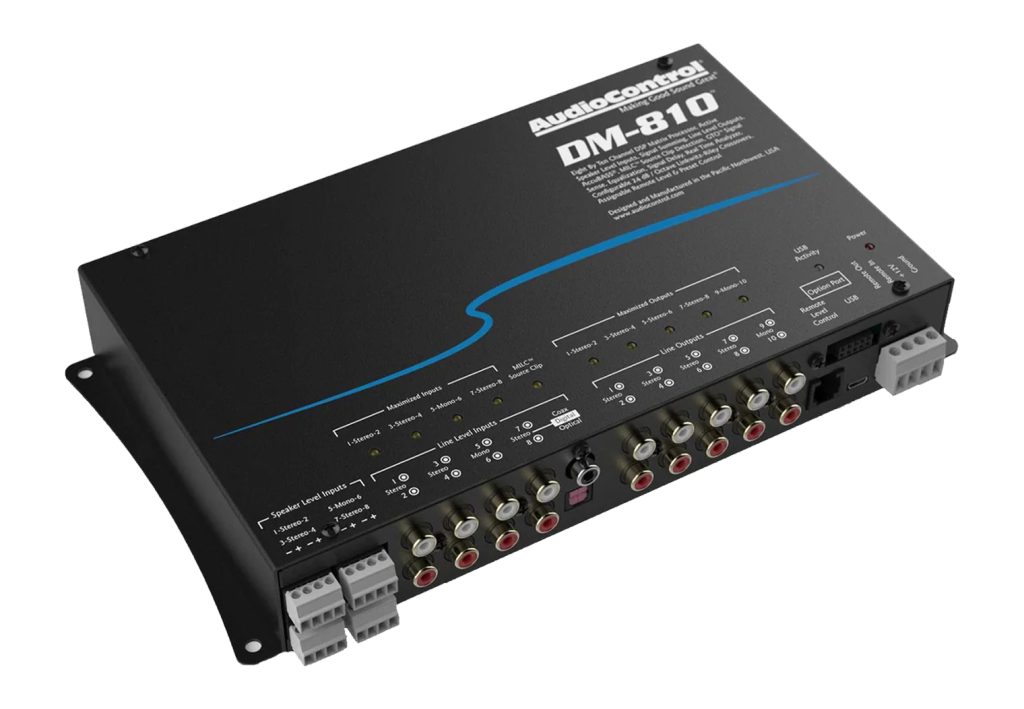
AudioControl DM-810
Make your factory head unit sing
CarAudioNow may earn a commission from retailer links. Brands do not influence the recommendations.
Why I picked it
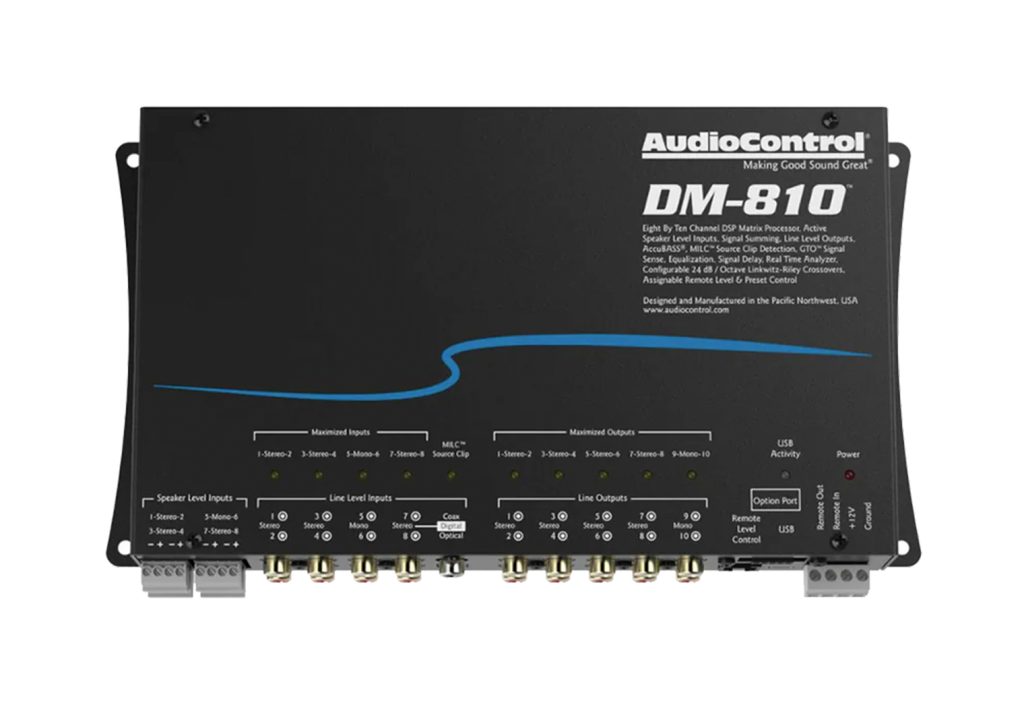
The AudioControl DM-810 solves one problem most car audio DSP processors overlook: making your factory head unit sound incredible without replacing it. Built-in AccuBASS, proprietary GTO Signal Sense for OEM de-equalization, and MILC (MultiInput Level Compensation) work together to extract the best possible signal from factory systems. The DM Smart DSP app (iOS and Android) makes tuning accessible — no laptop required. This is the best car audio DSP processor if your priority is retaining factory controls and maximizing OEM potential.
Bottom line: The DM-810 is the best car audio DSP processor for keeping your factory head unit while adding serious processing. To retain steering-wheel controls, satellite radio, and voice commands without sacrificing sound quality, see my guide on upgrading your OEM head unit without losing factory controls.
| Make | AudioControl |
| Model | DM-810 |
| Channels In/Out | 8 in / 10 out |
| Processor | ADAU Series DSP |
| Bit Depth / Sample Rate | 24-bit / 48kHz |
| THD+N | -95 dB |
| S/N Ratio | >100 dB |
| Inputs | 8x RCA (high/low, OEM summing) |
| Outputs | 10x RCA @ 4V |
| EQ Bands | 30-band parametric per channel |
| Time Alignment | ±300mm, 0.1ms resolution |
| Dimensions | 7.0″ W x 4.9″ H x 2.4″ D |
Reasons to buy
- AccuBASS, GTO Signal Sense, and MILC designed specifically for OEM signal correction
- DM Smart DSP app for phone/tablet tuning — no PC required
- 30-band parametric EQ with signal summing and phase correction
- Excellent integration with factory head units and controls
- Option Port for future hi-res streaming input
Reasons not to buy
- 24-bit/48kHz processing — not hi-res like Helix or miniDSP
- Output voltage limited to 4V vs 6–8V on competitors
- No digital input on base unit (requires Option Port accessory)
- Mobile app tuning is convenient but less powerful than PC tools
Alpine PXE-C80-88 OPTIM8
8-channel DSP + amp in one chassis
CarAudioNow may earn a commission from retailer links. Brands do not influence the recommendations.
Why I picked it
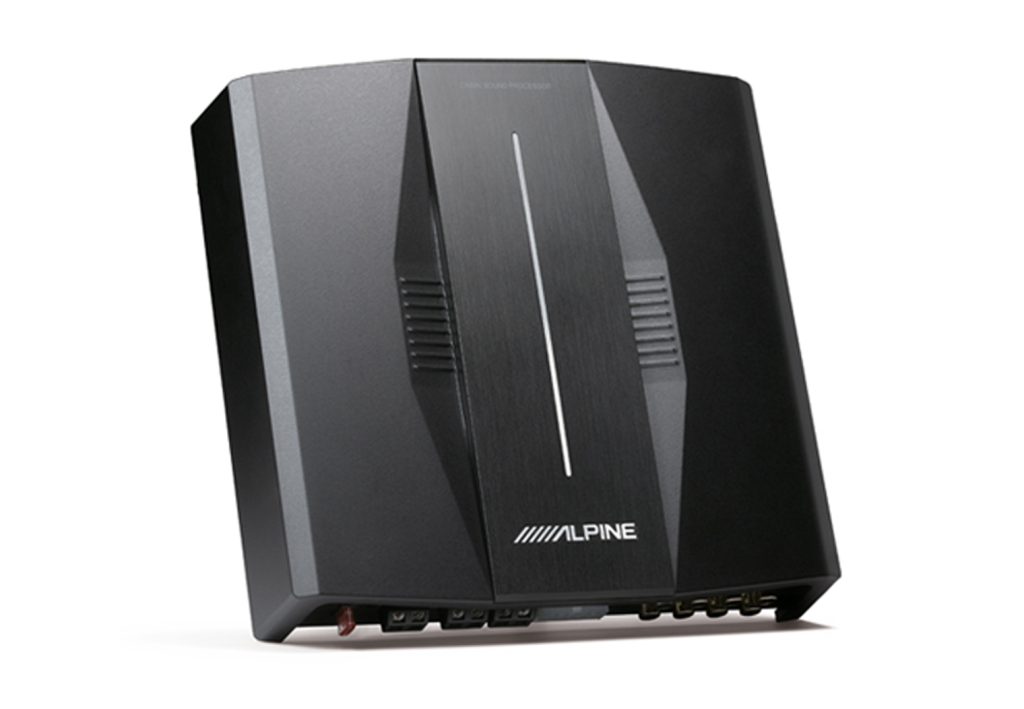
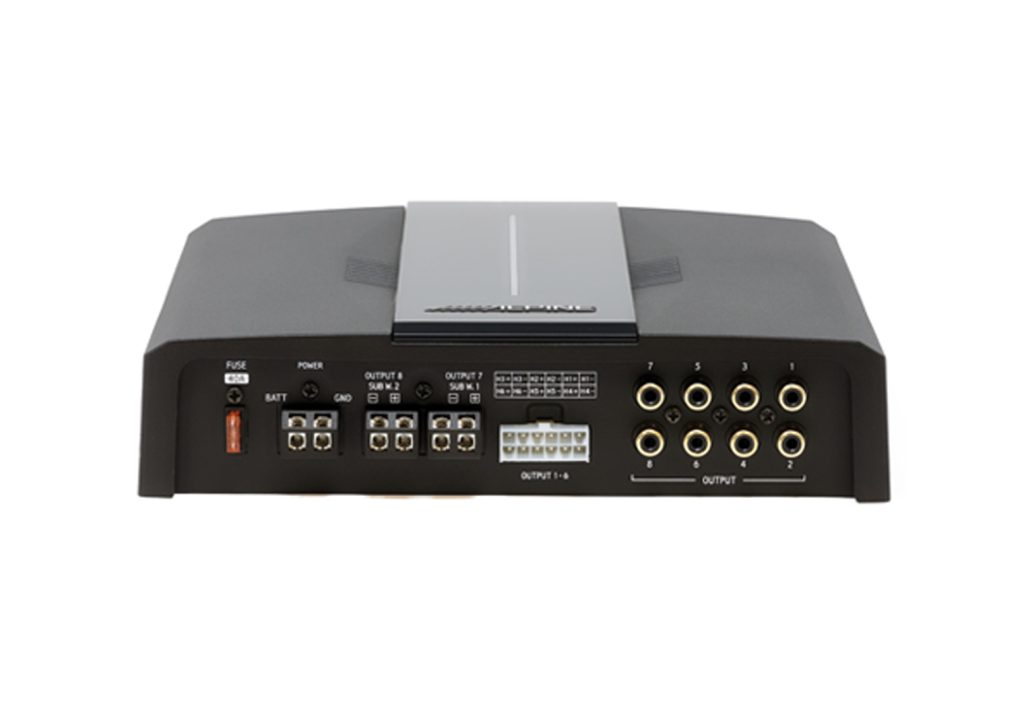
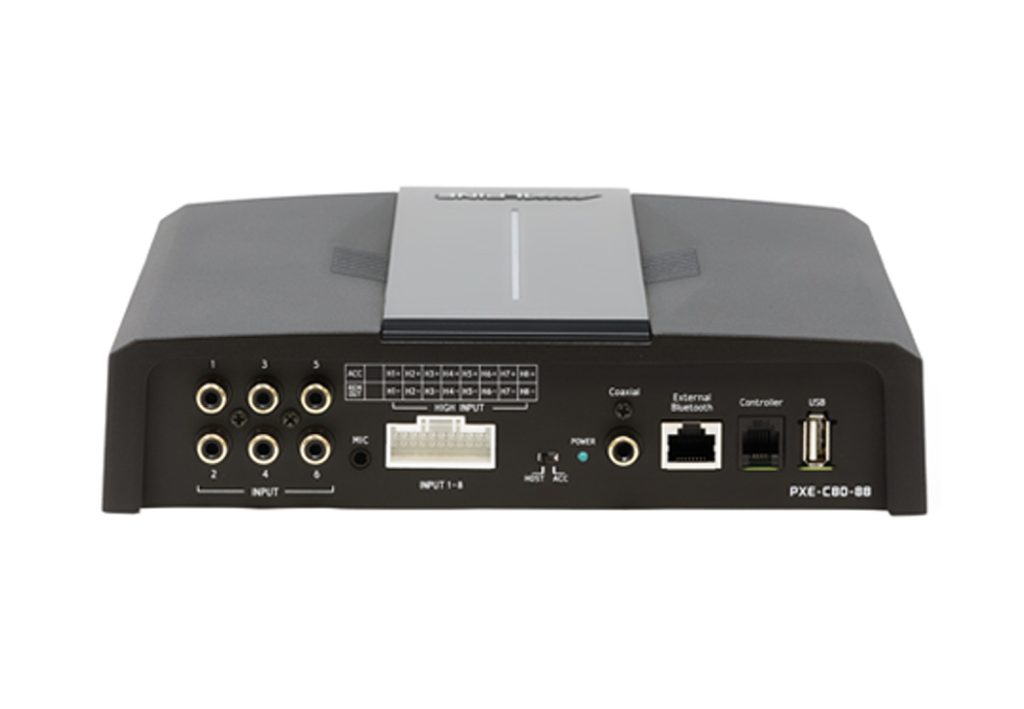
The Alpine PXE-C80-88 OPTIM8 is a game-changer for installers and DIYers who prioritize simplicity: it combines a full 8-channel car audio DSP processor with a built-in amplifier (50W x 6 channels + a 300W subwoofer channel at 2 ohms) in a single chassis. One box replaces separate DSP and amplifier components, freeing up space. Auto-tuning via smartphone app eliminates the need for a PC, and you get hi-res 96kHz/24-bit processing with 31-band parametric and graphic EQ. For builds where space and simplicity matter more than maximum power, this is the best all-in-one DSP solution.
Bottom line: The OPTIM8 is the best all-in-one car audio DSP and amplifier solution if you value simplicity and space — perfect for compact installs where everything integrated in one unit is a priority. Just verify the built-in power matches your speaker requirements before committing.
| Make | Alpine |
| Model | PXE-C80-88 OPTIM8 |
| Channels In/Out | 8 in / 8 out |
| Processor | Custom Alpine DSP |
| Bit Depth / Sample Rate | 24-bit / 96kHz |
| THD+N | -98 dB |
| S/N Ratio | >105 dB |
| Inputs | 8x RCA (high/low) |
| Outputs | 8x RCA (DSP) + 8x amplified channels |
| EQ Bands | 31-band parametric + graphic |
| Time Alignment | ±300mm |
| Power Output | 50W x 6 @ 4Ω + 300W @ 2Ω sub |
| Dimensions | 7.9″ W x 5.5″ H x 2.8″ D |
Reasons to buy
- Built-in 8-channel amplifier eliminates a separate amp for most systems
- Smartphone-controlled auto-tuning with step-by-step calibration
- Hi-res 96kHz/24-bit processing with 31-band parametric and graphic EQ
- Space-saving all-in-one design
- Compact form factor fits hidden installation locations
Reasons not to buy
- Amplifier power is modest (50W x 6 + 300W sub) — may need a supplemental amp for demanding systems
- Auto-tuning trades some precision for convenience vs manual tuning
- Premium price for the combo (~$800–1,000)
- Limited expansion options compared to standalone DSPs
Helix DSP.3S
Hi-res Helix value, no flagship price
CarAudioNow may earn a commission from retailer links. Brands do not influence the recommendations.
Why I picked it
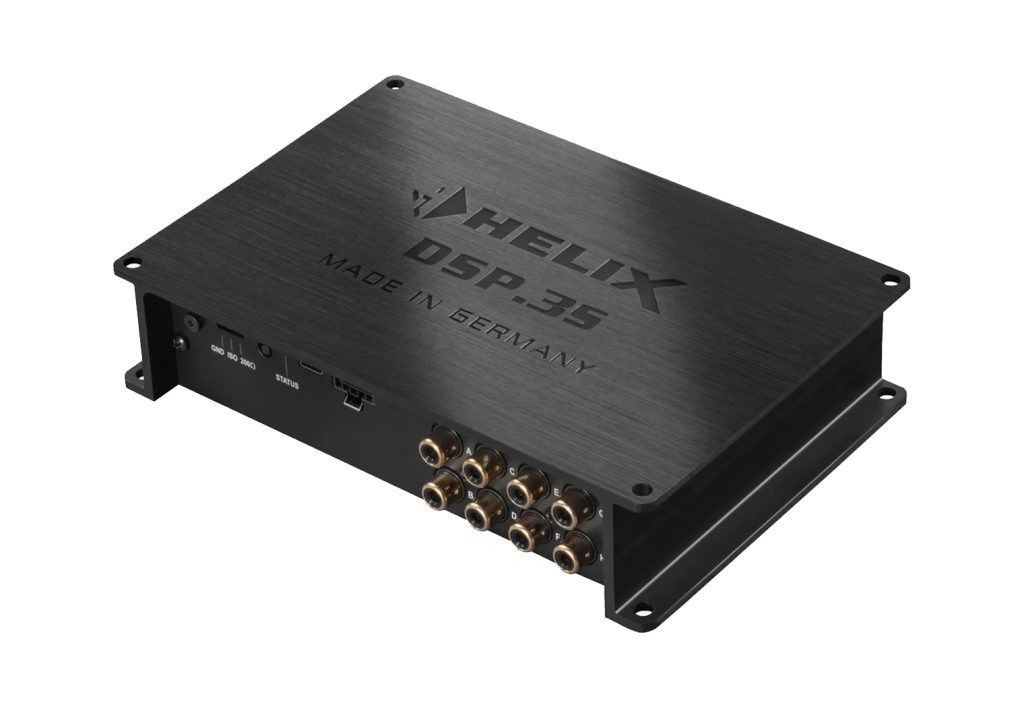
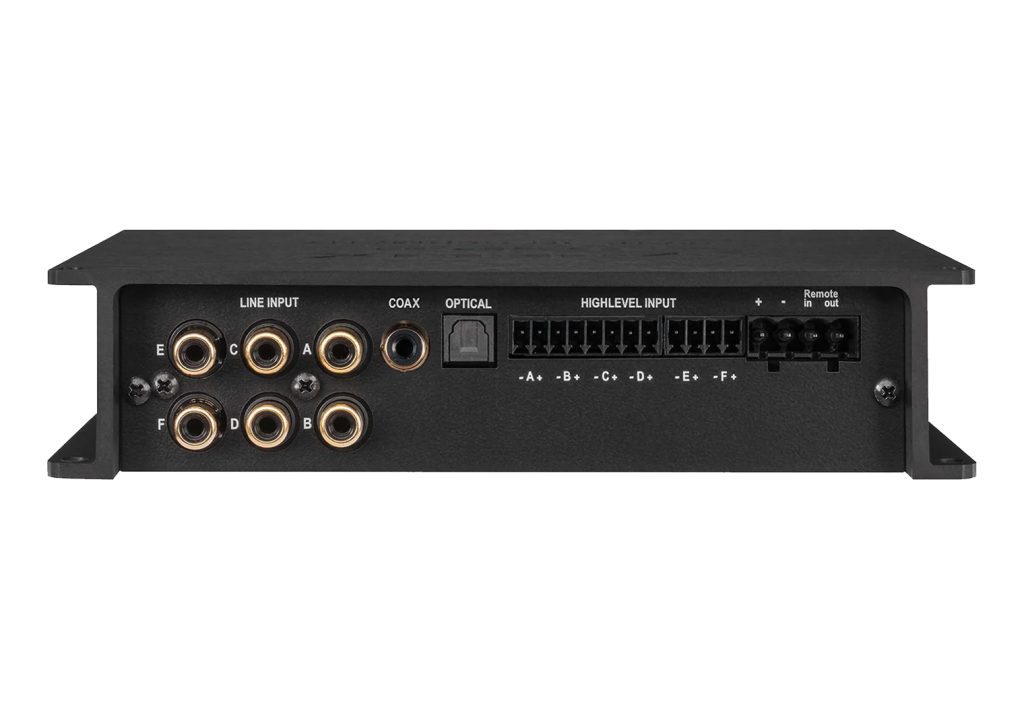
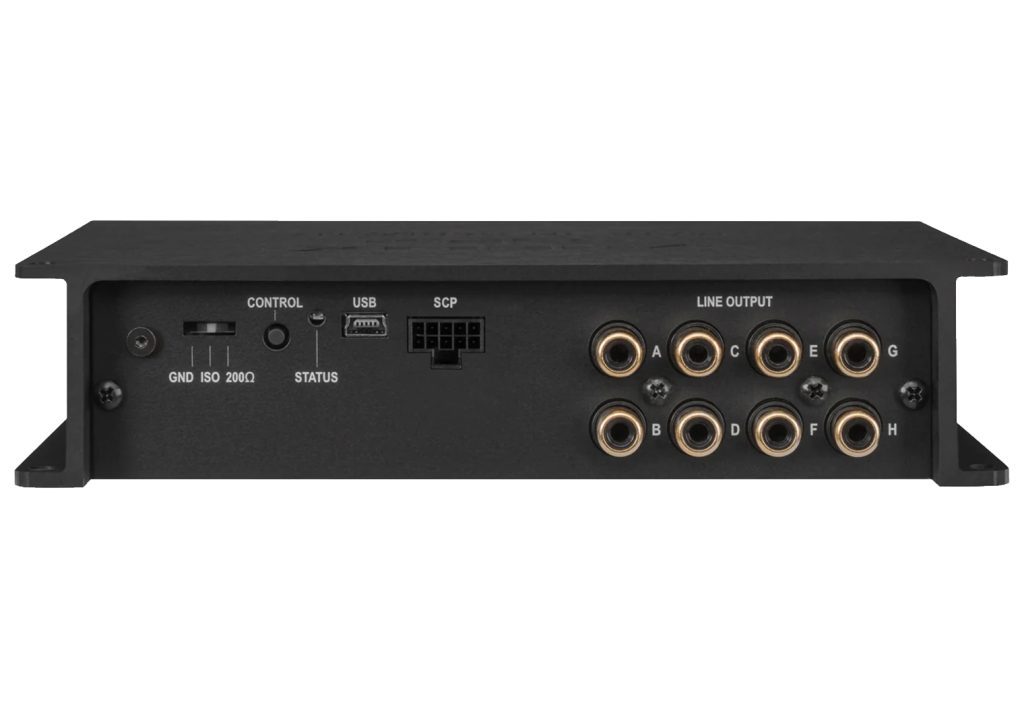
The Helix DSP.3S sits in Helix's mid-tier sweet spot with the latest 64-bit Sigma350 processor, BurrBrown converters, native 96kHz processing, and the HEC expansion slot for Bluetooth HD or USB streaming. It delivers 90% of what the Pro MK3 accomplishes at a lower price, making it the best value in the Helix lineup for enthusiasts who want hi-res processing without flagship pricing. The ACO platform provides the same advanced virtual-channel features as higher-end Helix models.
Bottom line: The DSP.3S is the best mid-range car audio DSP processor for enthusiasts who want serious performance without flagship pricing — my recommendation for most custom builds that don't require extreme complexity. Pair it with the right amplifier using my best car amplifiers guide.
| Make | Helix |
| Model | DSP.3S |
| Channels In/Out | 8 in / 8 out (+ virtual) |
| Processor | Sigma350 64-bit |
| Bit Depth / Sample Rate | 24-bit / 96kHz |
| THD+N | -101 dB |
| Inputs | 8x RCA (high/low), HEC slot |
| Outputs | 8x RCA + virtual via ACO |
| EQ Bands | 31-band parametric per channel |
| Time Alignment | ±500mm, mm precision |
| Dimensions | 7.1″ W x 5.1″ H x 2.6″ D |
Reasons to buy
- 64-bit Sigma350 processor with native 96kHz processing
- HEC expansion slot for Bluetooth HD, USB, and future accessories
- ACO platform with the same advanced features as higher Helix models
- BurrBrown converters deliver excellent audio quality at this price point
- Strong value — does most of what the Pro MK3 offers at lower cost
Reasons not to buy
- 8 outputs vs 10–12 on Pro MK3/Ultra S — limits extremely complex systems
- BurrBrown converters are excellent but a step below AKM Velvet Sound
- Still PC-only tuning via DSP PC-Tool (no mobile app)
- Not as powerful for extreme competition-level tuning
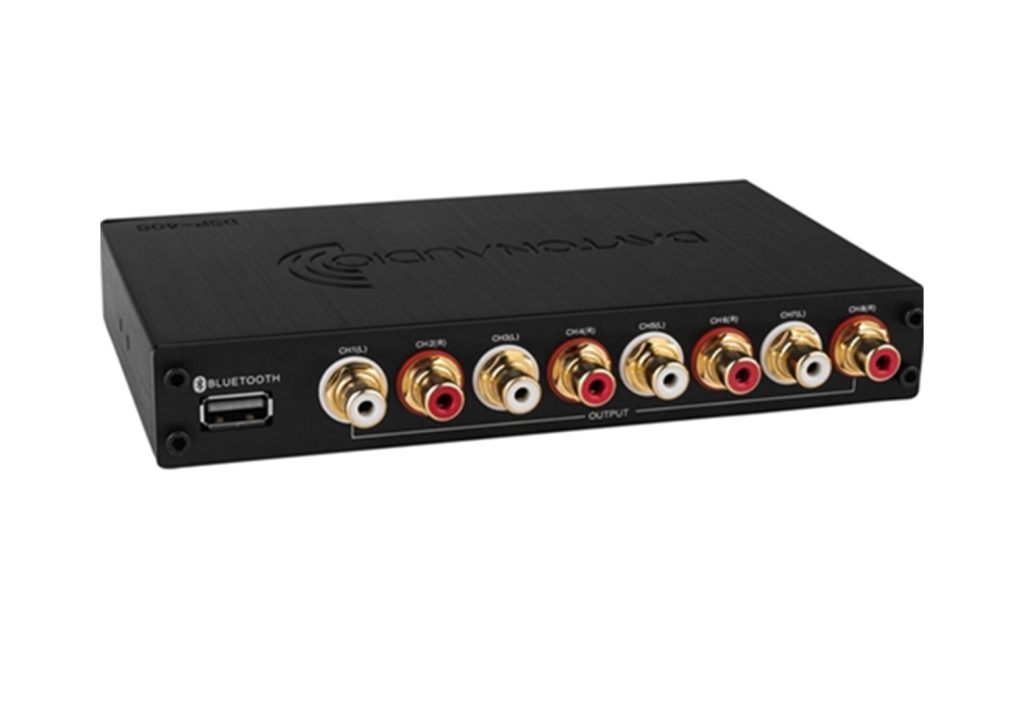
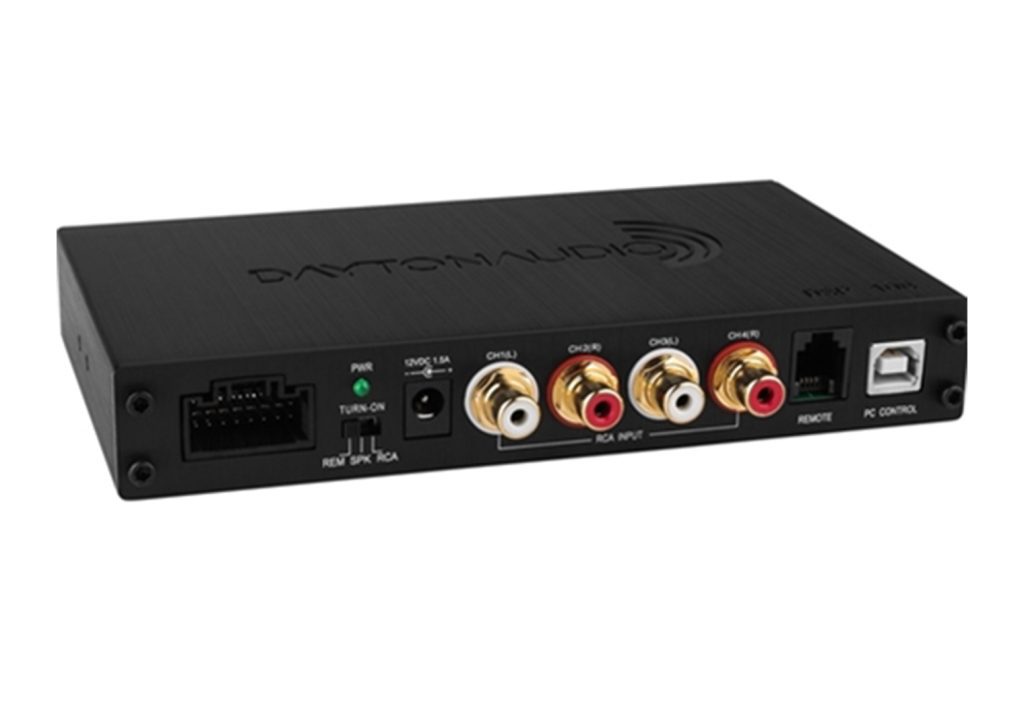
Dayton Audio DSP-408
Real DSP for about $200
CarAudioNow may earn a commission from retailer links. Brands do not influence the recommendations.
Why I picked it
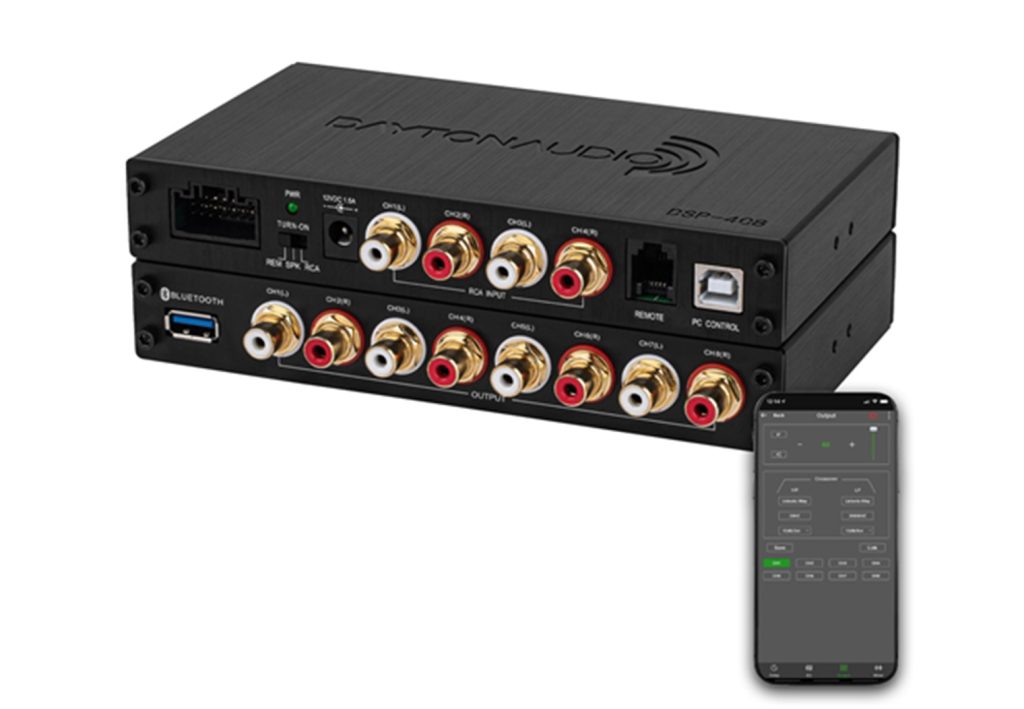
At ~$200 street price, the Dayton Audio DSP-408 is the easiest way to add real digital signal processing to any car audio system on a budget. It handles 4 inputs and 8 outputs with 10-band parametric EQ per channel, full crossovers, time alignment, and input mixing, using an Analog Devices ADAU1701 processor at 24-bit/48kHz. High-level inputs are included, so it integrates with factory systems. It won't compete with a Helix Ultra S on resolution, but for the price it will genuinely transform a basic system.
Bottom line: The DSP-408 is the best budget car audio DSP processor for entry-level builds and anyone who wants DSP without breaking the bank. You're not getting premium sound quality, but you're getting real functionality at a price that won't derail your budget — perfect for testing whether DSP integration is right for your system before investing more.
| Make | Dayton Audio |
| Model | DSP-408 |
| Channels In/Out | 4 in / 8 out |
| Processor | Analog Devices ADAU1701 |
| Bit Depth / Sample Rate | 24-bit / 48kHz |
| THD+N | -88 dB |
| S/N Ratio | >95 dB |
| Inputs | 4x RCA (high/low) |
| Outputs | 8x RCA |
| EQ Bands | 10-band parametric per channel |
| Time Alignment | ±300mm |
| Dimensions | 6.5″ W x 4.3″ H x 2.1″ D |
Reasons to buy
- Street price around $200 makes DSP accessible to any budget
- 8 outputs with full parametric EQ, crossovers, and time alignment
- Works for both car and home audio — versatile investment
- High-level inputs for factory system integration
- Plug-and-play installation
Reasons not to buy
- 24-bit/48kHz processing — no hi-res capability
- Windows-only tuning software with a dated interface
- No digital inputs (optical/coaxial) or expansion options
- 4-input limitation restricts complex systems
- Limited customer support compared to Helix or AudioControl
Dial in your DSP and amp together
A DSP is only as good as its tuning. Start with time alignment and crossovers before you touch EQ, keep signal cables away from power, and use a measurement mic to remove the guesswork. My amplifier-tuning quick guide walks the complete signal chain.
Frequently asked questions about car audio DSP processors
What does a car audio DSP actually do?+
A digital signal processor gives you complete control over how your system sounds by letting you adjust crossovers (which frequencies go to which speakers), time alignment (correcting delays from speaker placement), equalization, and phase between channels. It sits between your source (head unit) and your amplifier(s). Unlike an equalizer alone, a modern DSP handles all of this digitally at high bit depths and sample rates, preserving audio quality throughout the chain.
Do I need a DSP if I already have a good head unit?+
Most likely yes. Even high-end head units have limited crossover and time-alignment functionality. A dedicated DSP lets you fine-tune your system's acoustics in ways a head unit can't match. If you're running multiple amplifiers, a subwoofer, or integrating a factory system, a DSP is non-negotiable. The only exception is a simple 2-way system with no subwoofer — and even then, time alignment alone is worth it.
What's the difference between 24-bit and 32-bit DSP processing?+
32-bit processing provides more headroom and precision throughout the chain, resulting in lower distortion and cleaner audio at lower levels. 24-bit is still excellent and transparent for most systems, but 32-bit (found on the Helix DSP Ultra S and miniDSP C-DSP 8×12 DL) offers measurably better performance. For competition SQ builds or critical listening, 32-bit is worth the premium; for most practical builds, 24-bit at 96kHz is completely transparent.
Can I install a DSP with my factory head unit?+
Absolutely — it is one of the most common DSP applications in 2026. You want a processor with high-level (speaker-level) inputs and signal summing, like the AudioControl DM-810 or Helix models with high-level inputs. These let you retain your factory head unit, steering-wheel controls, and satellite radio while adding full DSP processing. Many OEM systems benefit immensely from signal summing and de-equalization.
Is auto-tuning (like Dirac Live) as good as manual tuning?+
Measurement-based auto-tuning is genuinely excellent — sometimes superior to tuning by ear. The miniDSP C-DSP 8×12 DL with Dirac Live uses precise microphone measurements and proprietary algorithms to correct your car. The trade-off is that it is less flexible for personal preference than manual EQ, so many installers use auto-tuning as a baseline and then refine by hand.
How much should I spend on a car audio DSP?+
Budget ~5–10% of your total car audio investment on a DSP. A $500 DSP makes sense if your amps and speakers total $5,000–10,000. For serious competition builds, $1,000+ on a flagship like the Helix DSP Ultra S is justified; for entry-level builds, the Dayton DSP-408 at ~$200 is a smart start. Match the DSP tier to your amps and speakers — mismatches waste money in both directions.
More of my DSP & audio-processing guides
Why trust CarAudioNow?
