
Best Car Stereos & Head Units
The Sony XAV-AX6000 is my best car stereo for most drivers in 2026. I bench-tested its screen, interface, wireless CarPlay, tuning, and HDMI input, then put it up against seven specialist-category winners for sound quality, factory integration, display size, fitment, and value.
The best car stereo for most people
The Sony XAV-AX6000 is the head unit I'd put at the top of a normal 2026 shopping list. Wireless CarPlay and Android Auto cover the way most people actually use a radio now, the capacitive screen is quick and easy to read, and three pairs of 5V outputs leave a clean path to amplifiers later. I like that the HDMI input and shallow chassis add options without making the interface feel busy.
That doesn't make it the right radio for every dash. A tightly integrated factory screen can make the Kenwood DAX1050XR — or even the radio that's already in there — the smarter path. The DNR1007XR solves built-in navigation, the KMM-X705 covers a conventional single-DIN opening, and the XAV-9000ES puts audio tuning ahead of screen size. This guide starts with those decisions, then shows the winner from each specialist category.
I've bench-tested the XAV-AX6000 and XAV-9000ES, and I've spent years installing head units, amplifiers, speakers, and factory-integration hardware. I didn't install every product below, and I'm not going to pretend otherwise. Where I didn't have the unit in hand, I researched and vetted it against current manufacturer documentation, firmware and warranty support, and the limitations that actually bite during an installation.
Already know the type of stereo you need?
This guide handles the broad decisions instead of repeating every specialist list. If one feature or format is already non-negotiable for you, skip ahead to the matching guide. This page shows each category winner. The specialist guide walks the full field, the alternatives, and the narrower tradeoffs.
Before you compare car stereos, make sure a radio swap makes sense
The first question isn't which receiver has the best screen. It's what your vehicle can take without losing functions you use every day. Start with the Vehicle Fit Guide, then use my dashboard-size finder to confirm whether the opening is single-DIN, double-DIN, or a vehicle-specific integrated design. A model can have a single-DIN chassis and still need room for a double-DIN-size screen, so read the face and the chassis measurements separately — they're two different numbers and only one of them is on the front of the box.
A traditional single-DIN opening is roughly two inches tall. A double-DIN opening is roughly twice that height and normally gives you room for a 6.75- to 7-inch fixed screen. A floating receiver suspends a larger panel in front of a smaller chassis. That can put a 10-inch display in an older opening, and it can just as easily cover a vent, a switch, a gauge, or the shifter. Measure the space in front of the dash, not just the hole behind it.
Many late-model vehicles integrate audio, climate controls, cameras, warning chimes, amplified sound, and settings into one factory interface. Check the exact trim and factory audio package, not just year, make, and model. A base radio and a premium amplified radio in the same vehicle need completely different parts, and finding that out with the dash apart is a bad afternoon.
When keeping the factory radio is the better upgrade
If the factory screen works fine and the only real problem is the wired CarPlay cable, I wouldn't pull the dash apart just to get rid of it. A wireless CarPlay or Android Auto adapter can be the cleaner and cheaper fix. If the goal is better sound, a quality factory stereo integration adapter, DSP, amplifier, and speakers may improve the system while keeping every factory screen and control.
I would replace the radio when the existing interface is slow or unreliable, the vehicle has a supported dash/integration path, or the new receiver unlocks features the factory system cannot add cleanly. I would keep it when replacement requires giving up cameras, climate functions, warning tones, or a stable OEM interface just to gain a different home screen.
Set the budget around the installed system, not the radio box
Under about $400, the best value is a current major-brand wireless receiver such as the JVC KW-M690BW. Between roughly $450 and $700, you can usually add a better screen, stronger preouts, a shallower chassis, HDMI, or more complete integration. Around $900 to $1,500, the money should buy a clear advantage such as premium tuning, a bonded 10-inch display, four-camera support, or a vehicle-specific direct-replacement path. A large screen by itself is not enough.
Leave room for the dash kit, harness or data interface, antenna adapter, USB retention, camera adapters, and labor. A late-model interface can add several hundred dollars before installation. Price the complete package before using a sale price to choose the receiver.
Choose the goal that matters every day
For most drivers, I prioritize reliable wireless phone integration, a screen that is readable in the sun, and controls that do not take several taps while driving. For an amplified system, I move preamp voltage, crossover flexibility, and time alignment higher. For a truck or off-road build, camera inputs and screen placement can matter more than an audio-format logo. For a late-model factory system, compatibility and retention come first.
Compare my 8 car stereo picks
| Type ↕ | My pick ↕ | Best for ↕ | Head Unit Size ↕ | Screen Size ↕ | Rating ↕ | Buy |
|---|---|---|---|---|---|---|
| Wireless CarPlay / Android Auto | 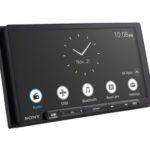 Sony XAV-AX6000 Sony XAV-AX6000 | Most drivers who want wireless phone integration and a clean amp-ready signal | Shallow chassis behind a double-DIN-size face | 6.95 in capacitive anti-glare | Buy Now $598.00 on Crutchfield | |
| Touchscreen / Floating Screen | 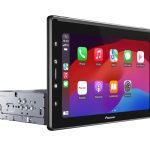 Pioneer DMH-WT6000NEX Pioneer DMH-WT6000NEX | A credible 10.1-inch floating display below four-figure pricing | 1-DIN chassis with floating display | 10.1 in capacitive floating | Buy Now $899.99 on Amazon | |
| Built-In GPS Navigation | 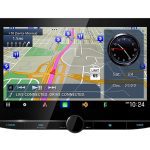 Kenwood Excelon Reference DNR1007XR Kenwood Excelon Reference DNR1007XR | Garmin navigation that works without a phone, plus a large display and four-camera support | 1-DIN floating; 6 1/8-in nominal depth plus rear-connection clearance | 10.1 in optically bonded capacitive | Buy Now $998.98 on Amazon | |
| Factory Integration | 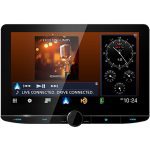 Kenwood Excelon Reference DAX1050XR Kenwood Excelon Reference DAX1050XR | Supported Maestro APX vehicles where factory controls matter most | Separate 1-DIN chassis with floating display | 10.1 in optically bonded capacitive | Buy Now $1,249.00 on Crutchfield | |
| Single-DIN | 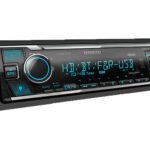 Kenwood Excelon KMM-X705 Kenwood Excelon KMM-X705 | A no-screen deck built around 5V outputs, sound tuning, and physical controls | Single-DIN, mechless; 3 15/16-in nominal depth plus rear-connection clearance | 0 in; 255-segment, 1.5-line text display only | Buy Now $219.00 on Amazon | |
| High-Resolution / Sound Quality | 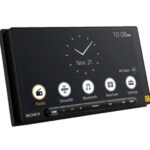 Sony XAV-9000ES Sony XAV-9000ES | A fixed-screen amplified system with deeper onboard tuning | Double-DIN face, shallow chassis | 6.75 in capacitive anti-glare | Buy Now $998.00 on Crutchfield | |
| In-Dash Video | 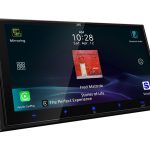 JVC KW-M795BW JVC KW-M795BW | A sharp fixed display, HDMI source, and HD backup-camera path around $500 | Double-DIN, 4 5/16-in chassis depth | 6.92 in capacitive anti-glare/anti-fingerprint | Buy Now $499.00 on Amazon | |
| Double-DIN | 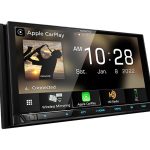 Kenwood Excelon Reference DMX958XR Kenwood Excelon Reference DMX958XR | HD Radio, HDMI, four cameras, and premium audio in one fixed screen | Double-DIN, short chassis | 6.75 in capacitive | Buy Now $999.00 on Amazon |
CarAudioNow may earn a commission from retailer links. Brands do not influence the recommendations.
How I test and choose car stereos
I start with fitment and the job the receiver actually has to do, then work through the controls, the phone connection, the audio path, integration, and the full installed cost — not the box price. I bench-tested the Sony XAV-AX6000 and XAV-9000ES and link those demonstrations where the hands-on findings back a pick. For the other finalists I used current manufacturer manuals and specifications, firmware and support pages, authorized-retailer listings, warranty terms, and a direct comparison against the alternatives in the same use case. Brands don't approve the picks or buy placement.
I look at face size, actual chassis depth, cable clearance, screen movement, and the adapters the vehicle needs. A radio can fit on paper and still cover a vent or leave nowhere for the harness.
I check startup, main-control access, glare, and wired fallback. Wireless convenience matters only when the connection and interface are dependable.
I compare RMS output honestly, preamp voltage, output pairs, EQ, time alignment, crossovers, and source support. More bands and more voltage give you options. Neither one fixes a weak installation.
I verify Maestro or other adapter support, cameras, HDMI, HD Radio, SiriusXM, USB, factory-amplifier retention, and vehicle-data options by exact application.
I compare the normal price tier with what the receiver adds, then check warranty length, authorized retail support, and visible firmware support.
Five questions that decide which stereo you need
- What will physically and electronically fit? Confirm the opening, depth, dash kit, factory sound package, and data interface before choosing a model. Screen size alone does not tell you whether it fits.
- Is the phone your main source? If navigation and music live on your phone, prioritize stable wireless CarPlay/Android Auto, useful controls, charging, and a wired fallback over built-in apps.
- Are you keeping factory features? List the steering controls, cameras, amplifier, chimes, climate screens, and vehicle settings you use. Verify each one against the exact adapter and trim.
- Will you add amplifiers or a DSP? Look for three output pairs, stronger preamp voltage, time alignment, and flexible crossovers. A basic speaker-only system does not need every tuning feature.
- What is the installed budget? Add the dash kit, harness, integration module, antenna and USB adapters, camera parts, labor, and tuning before comparing radio prices.
What is the best car stereo brand?
There's no single best brand across every dash and budget, and anyone who tells you otherwise is selling something. Sony is the easiest recommendation for a clean interface and a strong audio path. Kenwood is the deepest choice for integration, cameras, and system building. Pioneer is strongest when a large floating screen and broad adapter support lead the list. Alpine earns its place through shallow packaging and an established installation ecosystem. JVC often puts current display and wireless features at a lower price than the premium lines.
| Brand | Strongest lane | Main tradeoff | Start with |
|---|---|---|---|
| Sony | Clean daily interface and audio-first models | Fewer multimedia/tuner inputs on several models | XAV-AX6000 |
| Kenwood | Factory integration, cameras, tuning, and expansion | More complexity and higher flagship prices | DMX958XR |
| Pioneer | Large floating screens and broad adapter support | One-year warranty on many receivers | DMH-WT6000NEX |
| Alpine | Shallow installation and compact-system packaging | Screen resolution/value varies by model | iLX-W770-M |
| JVC | Current wireless and display features for less | Lower preout voltage or fewer physical controls | KW-M690BW |
Sony
I like Sony when you want a simple home screen, quick access to the main controls, wireless CarPlay/Android Auto, and a clear step-up path from a normal receiver to Mobile ES. The XAV-AX6000 is the sweet spot. The XAV-9000ES is the sound-first move.
Kenwood
Kenwood is where I look when the build needs more cameras, HDMI, HD Radio, three-way crossover control, stronger integration, or a more advanced DSP path. The tradeoff is complexity and higher flagship pricing.
Pioneer, Alpine, and JVC
Pioneer remains strong for large floating screens. Alpine often solves a shallow or crowded installation. JVC is the value brand I would check before dropping to an unknown Android radio. Read the exact model sheet because similarly named receivers can differ substantially.
Low-cost marketplace Android receivers can make sense when the budget is fixed and the return policy is strong, but I do not treat a long feature list as proof of stable firmware, clean output, or long-term support.
My 8 best car stereos for 2026, by category
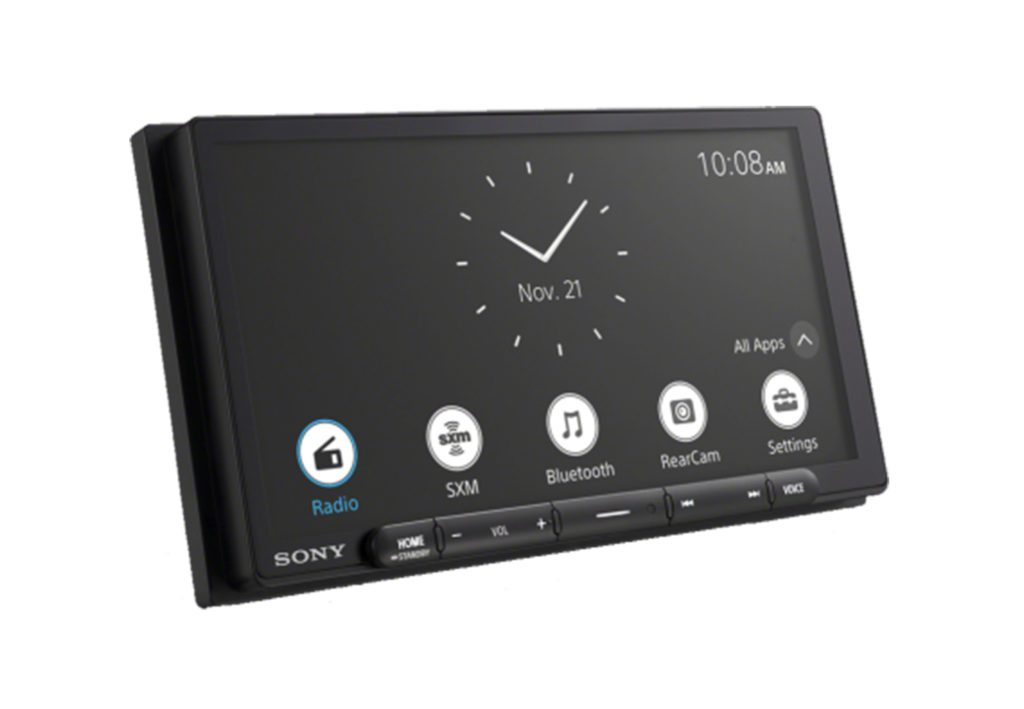
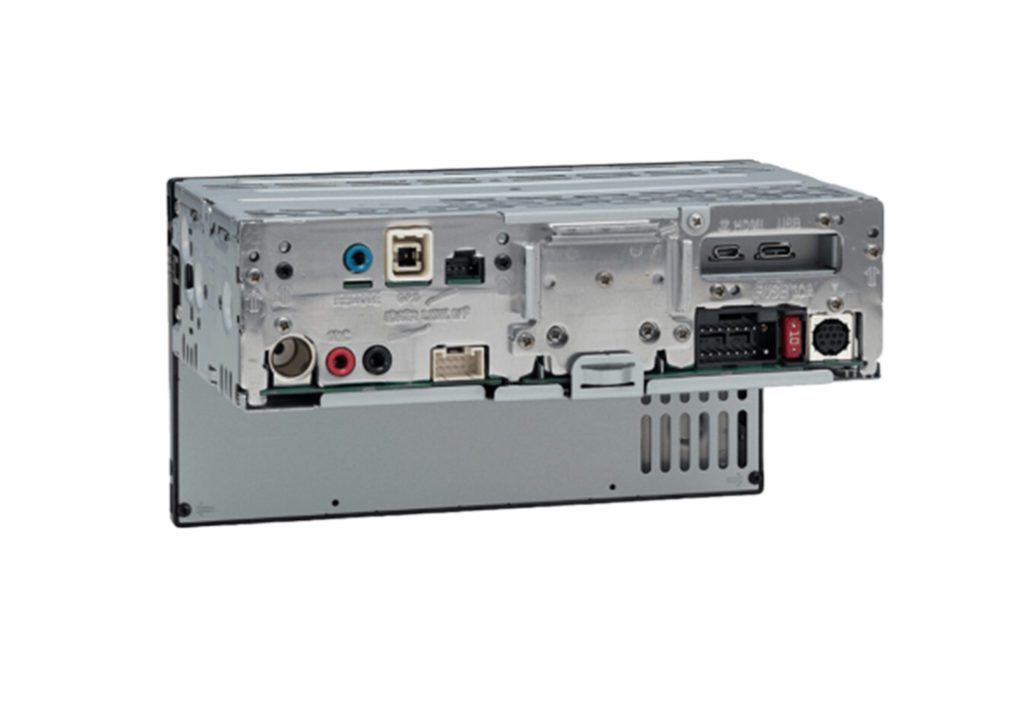
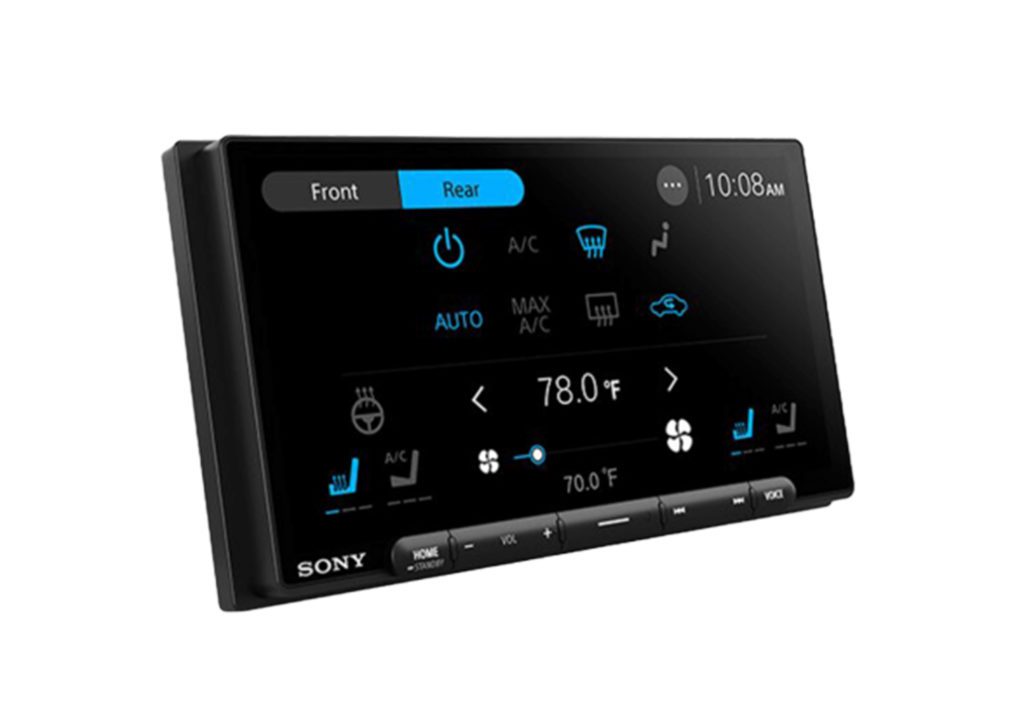
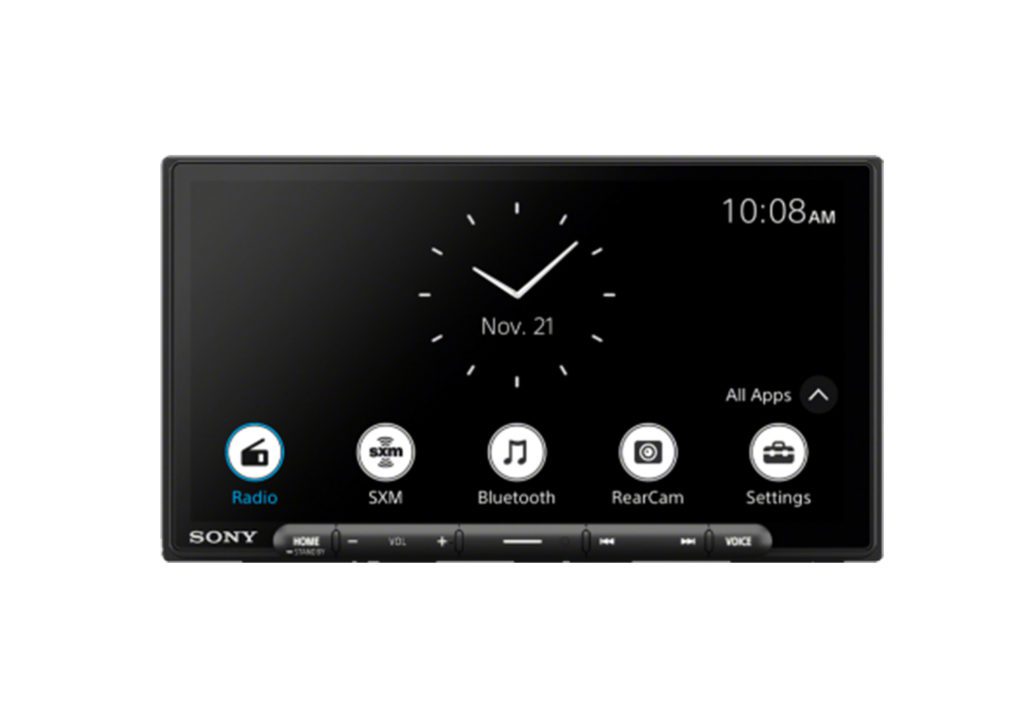
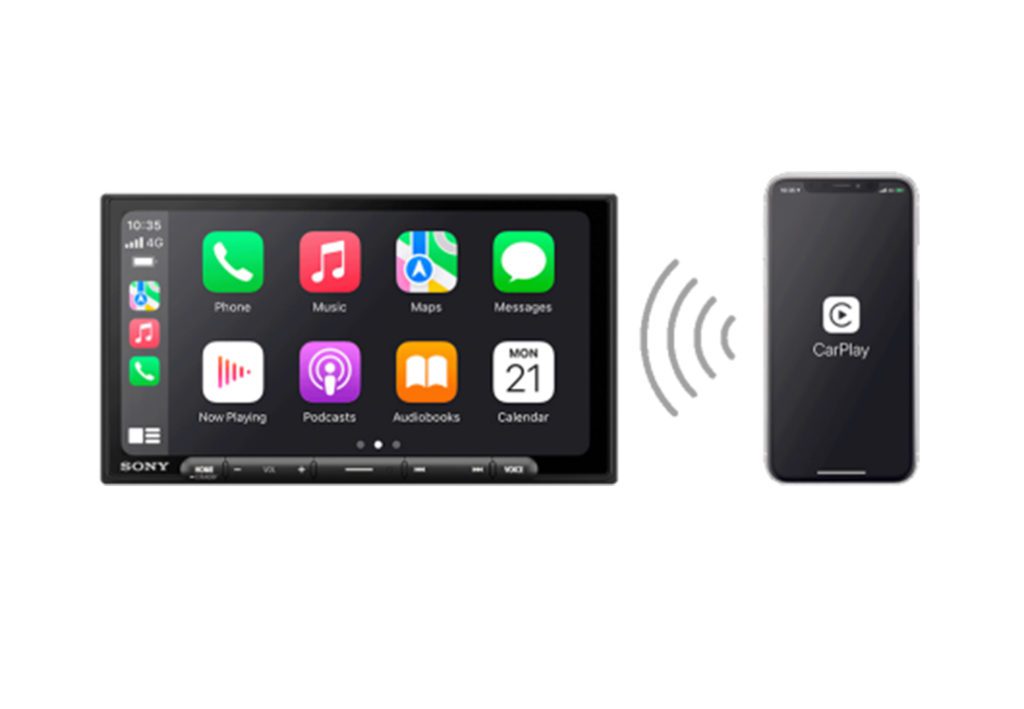
Sony XAV-AX6000
6.95-inch capacitive screen · wireless CarPlay/AA · 5V preouts · HDMI
CarAudioNow may earn a commission from retailer links. Brands do not influence the recommendations.
Why I picked it
The XAV-AX6000 is my best overall car stereo because it gets the daily stuff right without boxing you out of a better system later. I put it beside the AX4000 on my bench, powered both, worked through the menus, paired an iPhone wirelessly, and ran its HDMI input. The 6.95-inch capacitive screen came up a little brighter and clearer than the AX4000's resistive panel, and the interface booted in roughly four to five seconds. Wireless CarPlay behaved itself — no lag, no audio dropouts, none of the small daily annoyances that make an otherwise good receiver wear on you.
The real difference is behind the dash. You get three pairs of 5V preamp outputs instead of the AX4000's 2V, plus a 14-band EQ, time alignment, front and rear high-pass control, and a subwoofer low-pass filter. That's enough to tune a clean speaker-and-sub build. The stronger preamp signal also hands an aftermarket amp more usable voltage — think of it as speaking at a normal volume instead of a whisper the amp has to strain to hear. HDMI also gives you a real parked-video source that sound-first receivers usually skip.
There's one camera input, no built-in HD Radio, and the 800 by 480 panel is responsive rather than genuinely high definition. It normally runs from the mid-$500s to around $700, and Sony covers it for three years through an authorized channel. If you want the best balance of phone integration, straightforward controls, tuning, and room to add amplifiers, this is where I'd start.
| Make | Sony |
| Model | XAV-AX6000 |
| Head Unit Size | Shallow chassis behind a double-DIN-size face |
| Screen Size | 6.95 in capacitive anti-glare |
| Display Resolution | 800 x 480 |
| Smartphone Integration | Wired/wireless Apple CarPlay and Android Auto |
| Preamp Voltage | 5V, front/rear/sub |
| Power Output | 20W RMS x 4 CTA-2006 |
| Audio Tuning | 14-band EQ, time alignment, crossovers |
| Camera Inputs | 1 rear camera |
| Factory Integration | Maestro RR/RR2 ready, vehicle dependent |
| Media / Expansion | USB-C, micro-HDMI, SiriusXM-ready, LDAC |
| Warranty | 3 years when purchased through Sony/authorized channel |
| Typical Price Range | Mid-$500s to around $700 |
Reasons to buy
- Bench-tested wireless CarPlay, quick start-up, and an interface that stays out of the way.
- Three pairs of 5V outputs hand an amplifier a stronger, cleaner input signal.
- Capacitive anti-glare screen is more responsive and clearer than the AX4000's resistive panel.
- HDMI input adds a real parked-video or screen-mirroring path.
- Three-year Sony warranty against the one year common at this price.
Reasons not to buy
- Only one camera input, so a multi-camera build needs a different deck.
- No built-in HD Radio tuner.
- 800 x 480 resolution is ordinary next to newer 720p receivers.
- Hard keys help, but there's no physical volume knob.
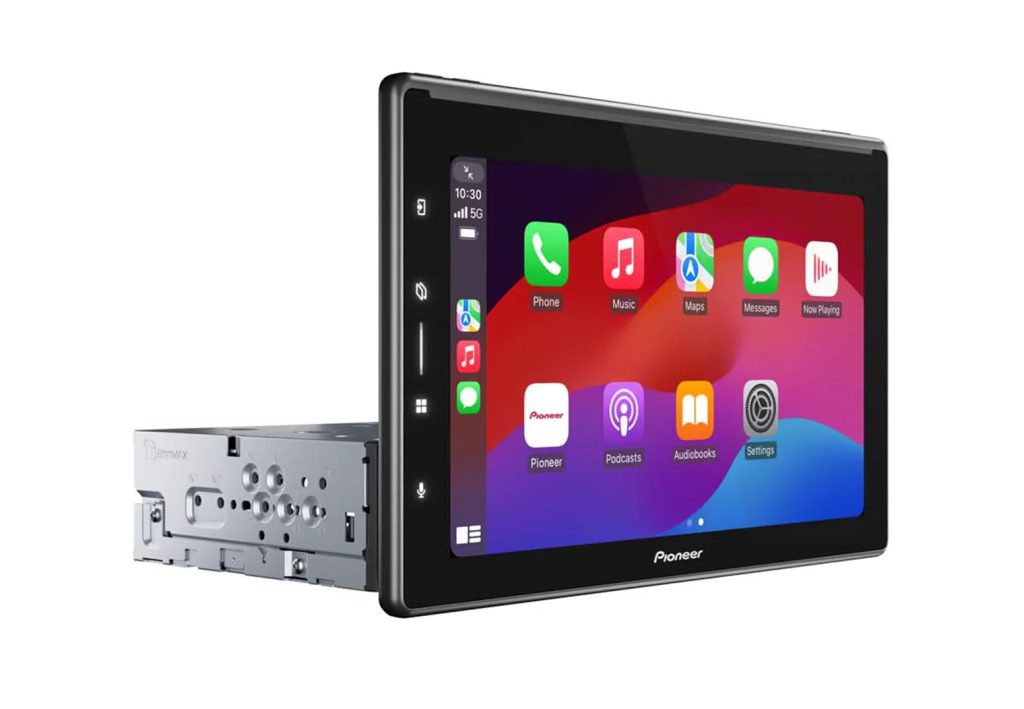
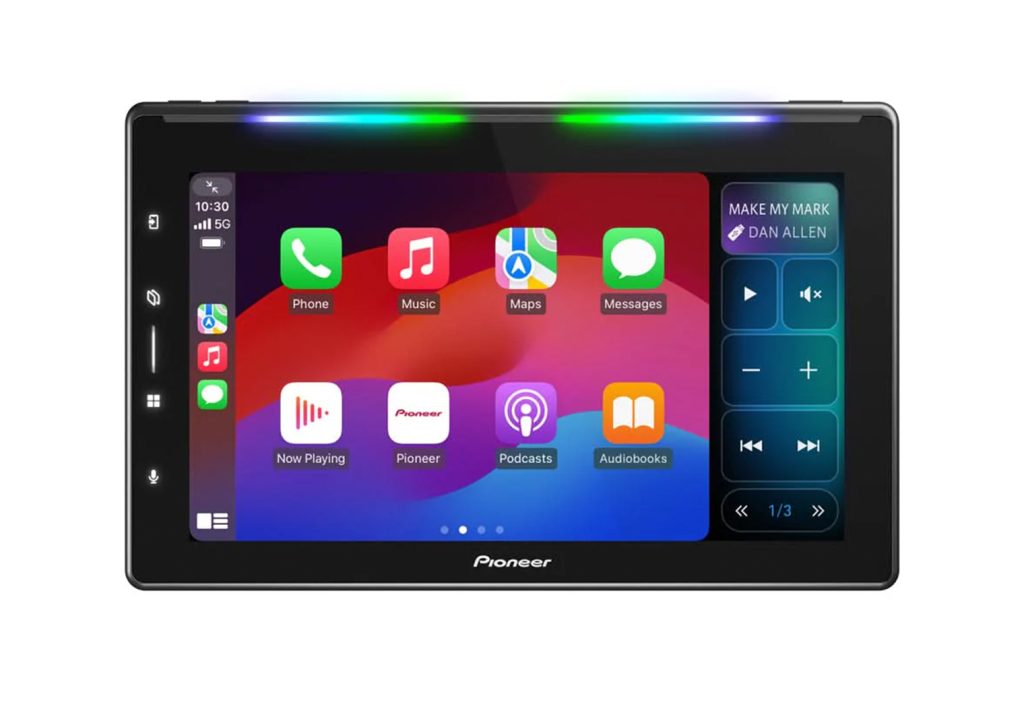
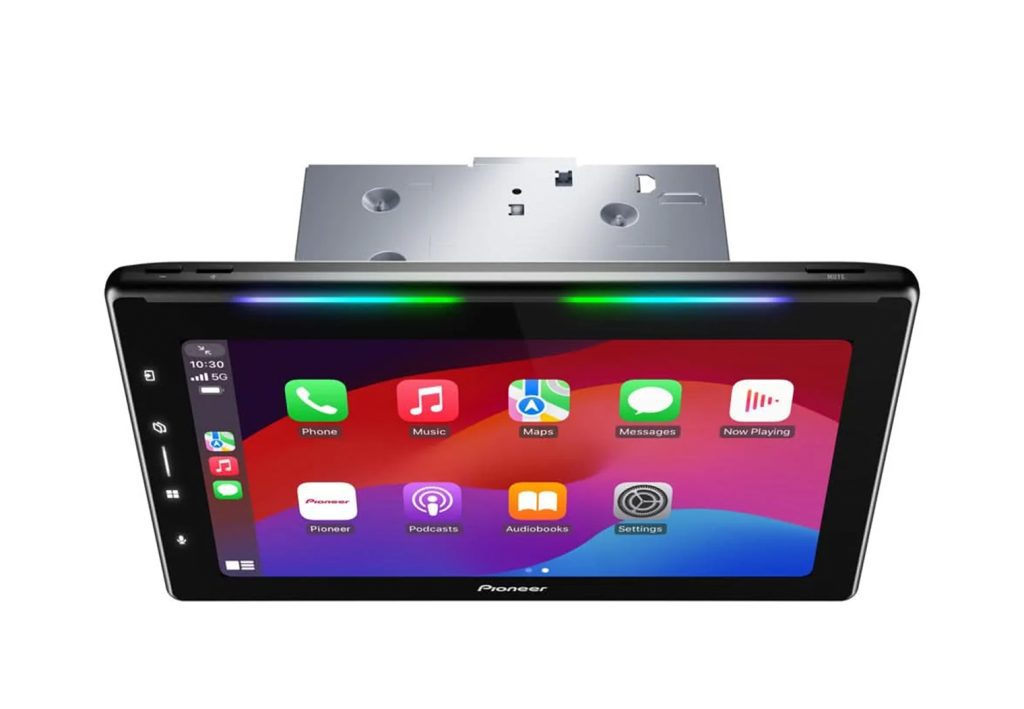
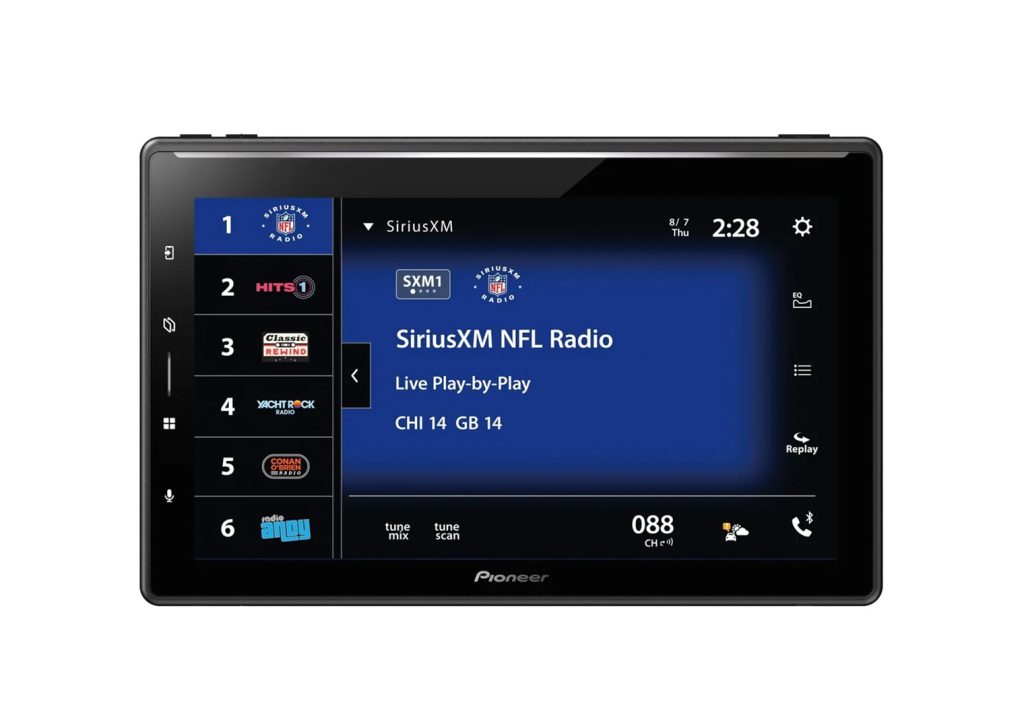
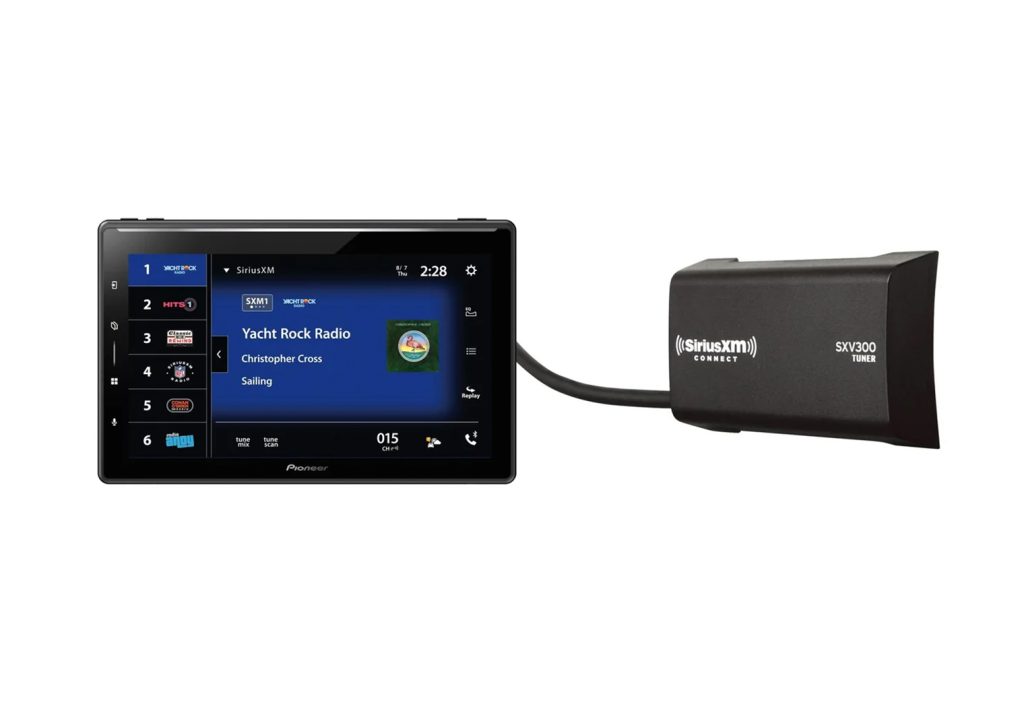
Pioneer DMH-WT6000NEX
10.1-inch 720p display · wireless CarPlay/AA · 4V preouts
CarAudioNow may earn a commission from retailer links. Brands do not influence the recommendations.
Why I picked it
The DMH-WT6000NEX is my big-screen value pick because it puts a current 10.1-inch 1280 by 720 floating display under four figures without gutting the feature list to get there. It runs around $900, below the usual tier for premium 10-inch receivers. The screen mounts to a 1-DIN chassis and adjusts for height, depth, tilt, and horizontal position at install. That flexibility isn't a luxury. A panel this size either looks factory-integrated or covers a vent, a climate button, or the shifter path, with very little in between.
Wireless and wired CarPlay and Android Auto are standard, and Pioneer adds built-in HD Radio, SiriusXM support, Maestro RR/RR2, Metra Axxess compatibility, two camera inputs, three pairs of 4V outputs, a 13-band EQ, time alignment, and three-way crossover modes. I haven't installed this exact WT6000, so I'm leaning on Pioneer's documentation, retail-channel support, and the feature mix. It's a more sensible buy than the older WT8600NEX, which sits in a much higher price tier for a similar screen.
The limits are real ones. Internal output is 14 watts RMS per channel under CTA-2006, the warranty is only a year, and there's no HDMI input. Pioneer also notes that supported high-resolution WAV and FLAC files get downsampled on playback, which is why I wouldn't hand it the hi-res award. For a driver who wants a large, sharp, adjustable screen with strong phone integration and normal room to add amplifiers, around $900 is a fair deal.
| Make | Pioneer |
| Model | DMH-WT6000NEX |
| Head Unit Size | 1-DIN chassis with floating display |
| Screen Size | 10.1 in capacitive floating |
| Display Resolution | 1280 x 720 |
| Smartphone Integration | Wired/wireless Apple CarPlay and Android Auto |
| Preamp Voltage | 4V, front/rear/sub |
| Power Output | 14W RMS x 4 CTA-2006 |
| Audio Tuning | 13-band EQ, time alignment, standard/3-way crossovers |
| Camera Inputs | 2 |
| Factory Integration | Maestro RR/RR2 and Metra Axxess, vehicle dependent |
| Media / Expansion | HD Radio, SiriusXM-ready, USB, A/V input; no HDMI |
| Warranty | 1 year parts and labor |
| Typical Price | Around $900 |
Reasons to buy
- A current 10.1-inch 1280 x 720 floating display for around $900.
- Adjusts for height, depth, tilt, and horizontal position during install.
- Built-in HD Radio, SiriusXM, plus Maestro RR/RR2 and Metra Axxess support.
- Three pairs of 4V outputs with 13-band EQ, time alignment, and three-way crossovers.
- Wireless and wired CarPlay and Android Auto both standard.
Reasons not to buy
- One-year warranty, against two or three years from Kenwood and Sony.
- No HDMI input at all.
- High-resolution WAV and FLAC files are downsampled on playback.
- 14 watts RMS per channel under CTA-2006, so plan on amplifiers.
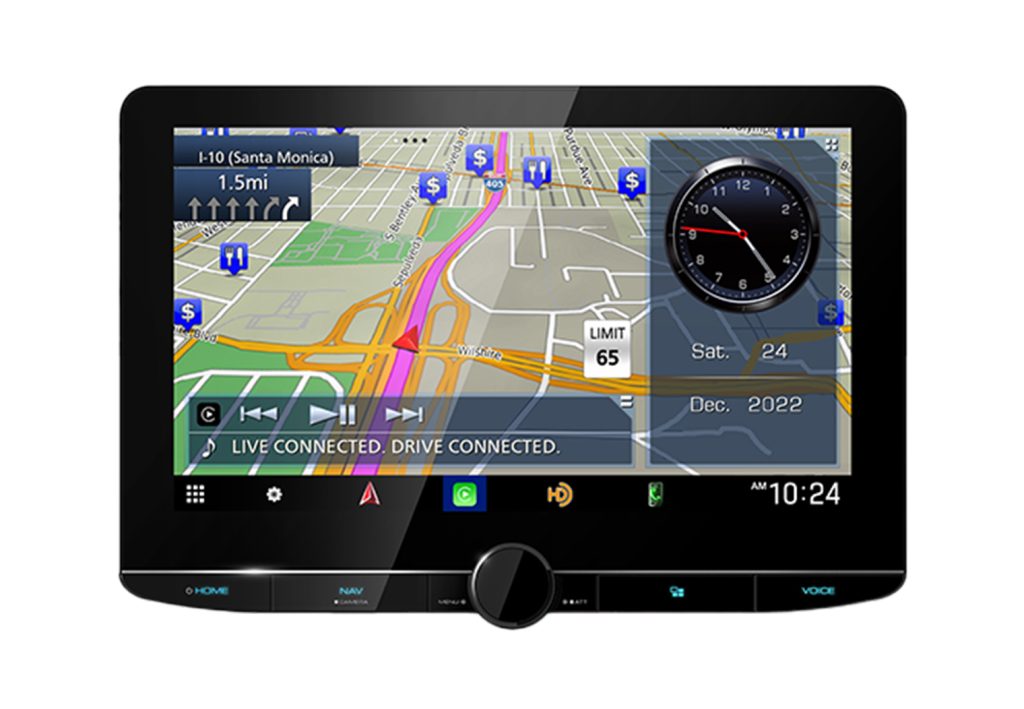
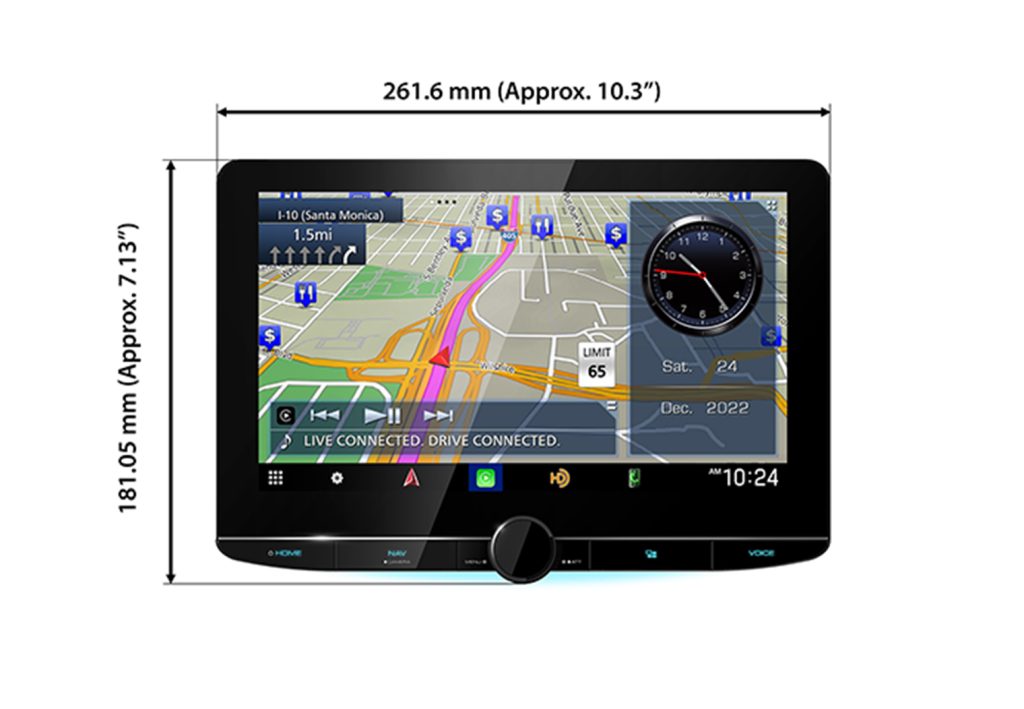
Kenwood Excelon Reference DNR1007XR
10.1-inch 720p display · built-in Garmin · 5V preouts · four cameras
CarAudioNow may earn a commission from retailer links. Brands do not influence the recommendations.
Why I picked it
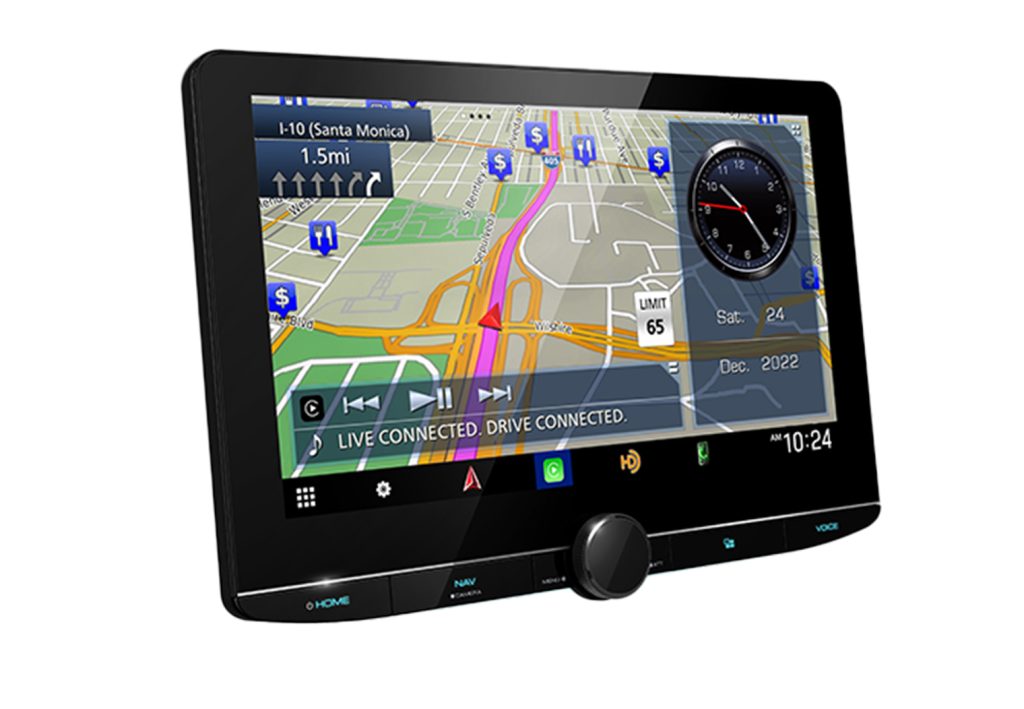
I picked the DNR1007XR for drivers who want real onboard navigation, not phone maps mirrored onto a screen. Its built-in Garmin system keeps routing when there's no cell service, with lane guidance, junction views, and terrain detail. Kenwood calls the update program 3 Years Map Care, but the current notice schedules map support only through December 31, 2028 — worth knowing before you buy. The 10.1-inch bonded capacitive display runs 1280 by 720 on an adjustable floating mount, so maps are far easier to read than on an older seven-inch deck.
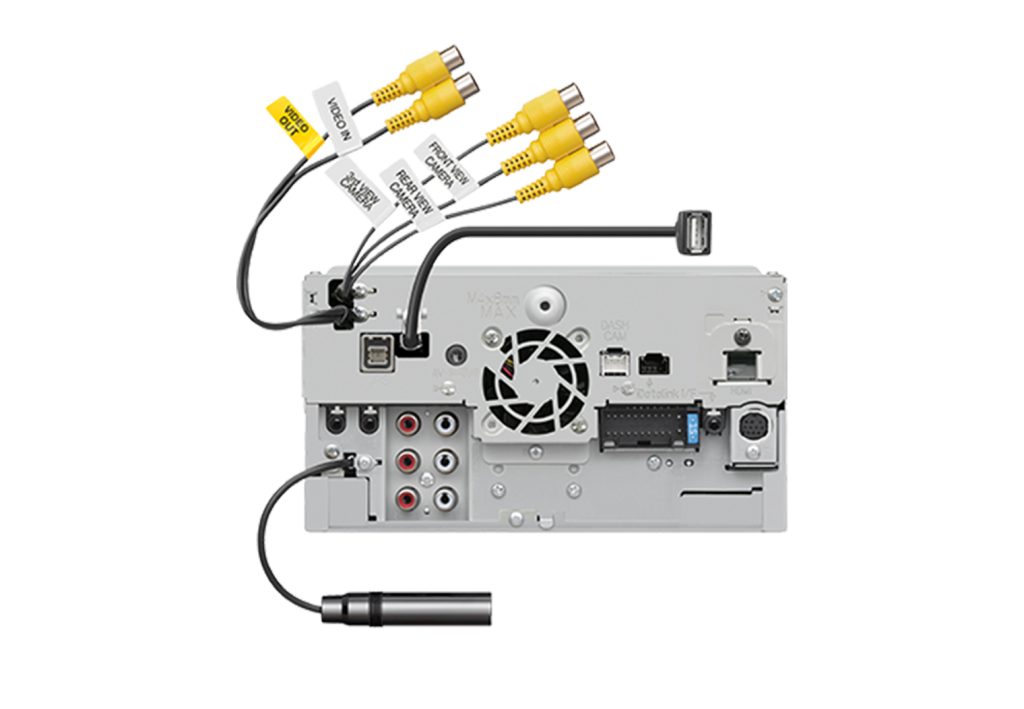
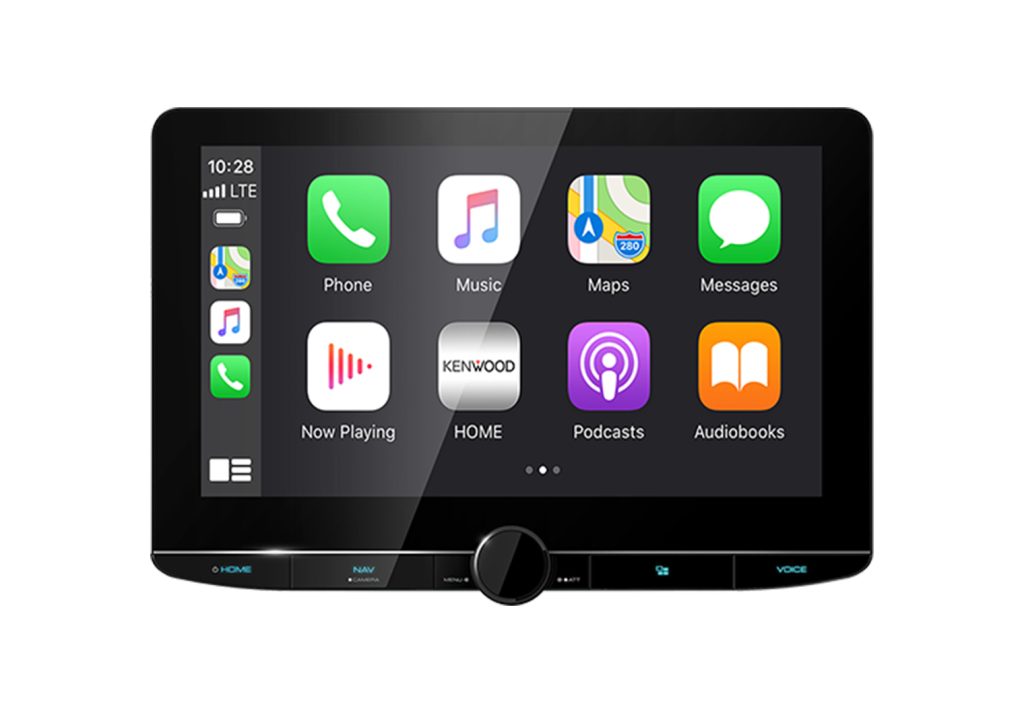
It's more than a navigation screen, though. Kenwood specifies three pairs of 5V outputs, 22 watts RMS per channel at under one percent distortion, wireless and wired CarPlay and Android Auto, LDAC, HD Radio, HDMI, Maestro support, and four camera inputs. I haven't installed or bench-tested this exact receiver, so I'm treating all of that as researched and manufacturer-verified rather than something I've confirmed with my own hands.
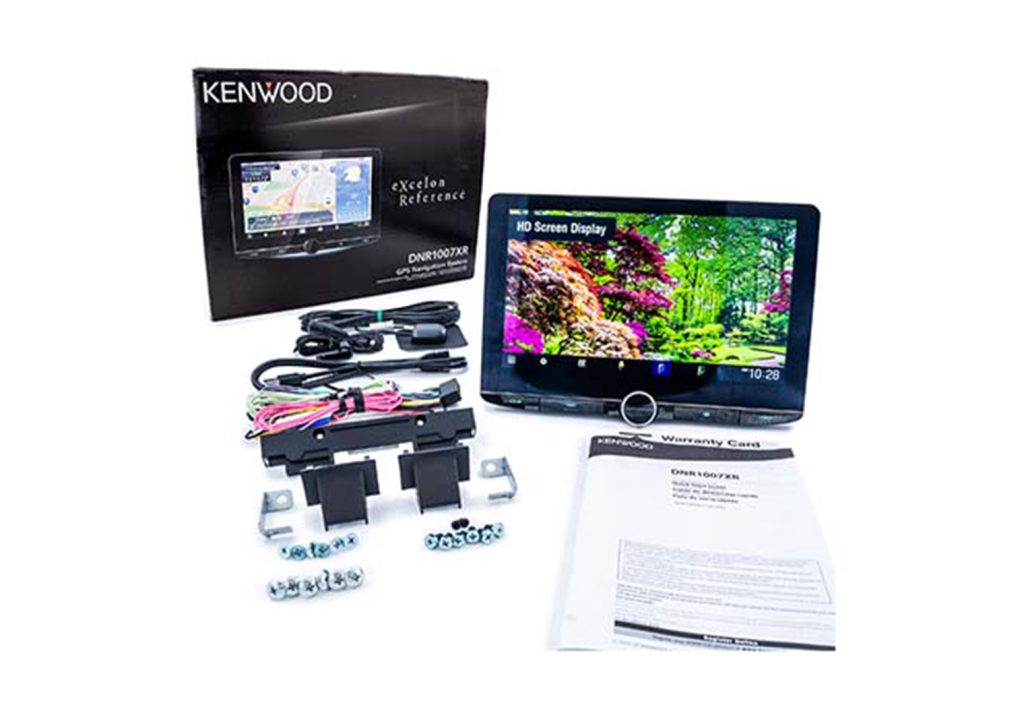
It's priced around $1,400 with a two-year warranty through an authorized Kenwood retailer. That big panel needs careful vent, switch, and shifter clearance, and the 6 1/8-inch nominal chassis depth still wants room behind it for the harness and rear connections. There's no CD or DVD transport either. If you need maps that keep working past the edge of cell coverage, and you want premium audio and camera expansion in the same box, it's the strongest all-in-one here.
| Make | Kenwood |
| Model | Excelon Reference DNR1007XR |
| Head Unit Size | 1-DIN floating; 6 1/8-in nominal depth plus rear-connection clearance |
| Screen Size | 10.1 in optically bonded capacitive |
| Display Resolution | 1280 x 720 |
| Smartphone Integration | Wired/wireless Apple CarPlay and Android Auto |
| Navigation | Built-in Garmin; map support currently scheduled through December 31, 2028 |
| Preamp Voltage | 5V, front/rear/sub |
| Power Output | 22W RMS x 4 at less than 1% THD |
| Audio Tuning | 13-band EQ, time alignment, 2-way/3-way crossovers |
| Camera Inputs | 4 |
| Factory Integration | Maestro RR/RR2 ready, vehicle dependent |
| Media / Expansion | HDMI, HD Radio, USB, LDAC, SiriusXM-ready |
| Warranty | 2 years |
| Typical Price | Around $1,400 |
Reasons to buy
- Built-in Garmin navigation keeps routing without a phone or cell service.
- Large bonded 1280 x 720 display makes maps and camera views easy to read.
- Three 5V preout pairs with two-way and three-way crossover modes.
- Four camera inputs, HDMI, HD Radio, and Maestro support for real expansion.
- Two-year Excelon warranty through an authorized retailer.
Reasons not to buy
- The large floating panel needs careful vent, switch, and shifter clearance.
- Nominal 6 1/8-inch depth still needs extra room for harness and connections.
- Around $1,400, and scheduled map support ends in 2028.
- No CD or DVD transport if you still run discs.
Kenwood Excelon Reference DAX1050XR
10.1-inch bonded display · Maestro APX · 5V and optical outputs
CarAudioNow may earn a commission from retailer links. Brands do not influence the recommendations.
Why I picked it
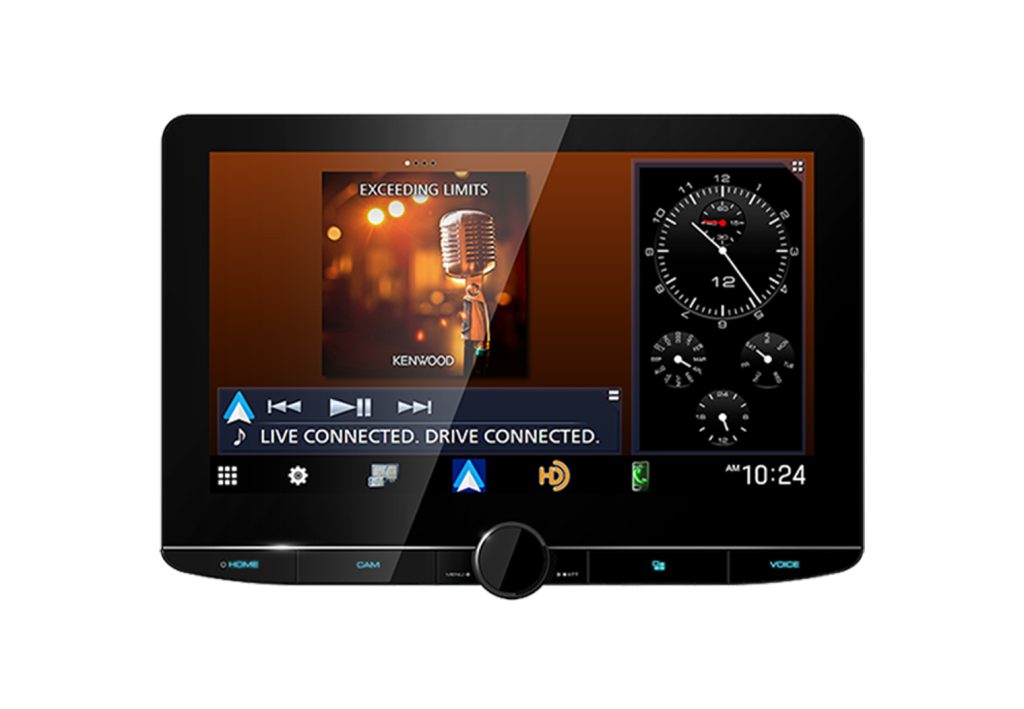
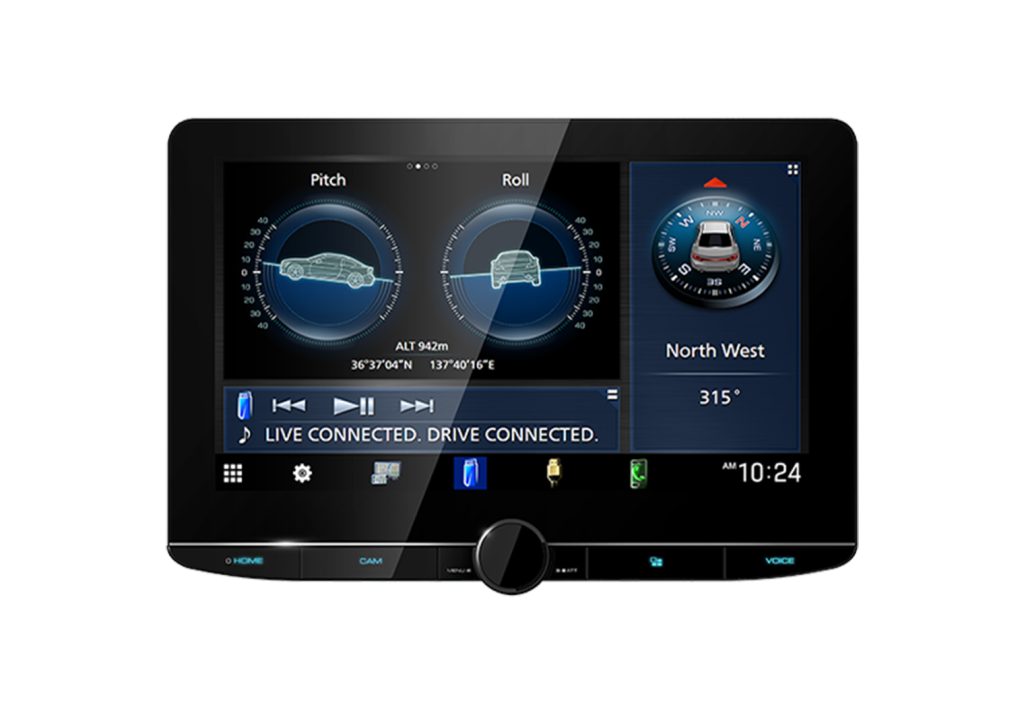
I picked the DAX1050XR for a late-model problem: the factory screen has to come out, but everything tied to it still has to work. Kenwood built this receiver around Maestro APX Direct Replacement kits, with a separate 1-DIN chassis that mounts horizontally or vertically away from the 10.1-inch screen. In a supported vehicle that's a far cleaner path to keeping steering-wheel controls, the factory amplifier, secondary displays, climate information, and vehicle data. The alternative is a generic radio and a shoebox of one-off adapters.
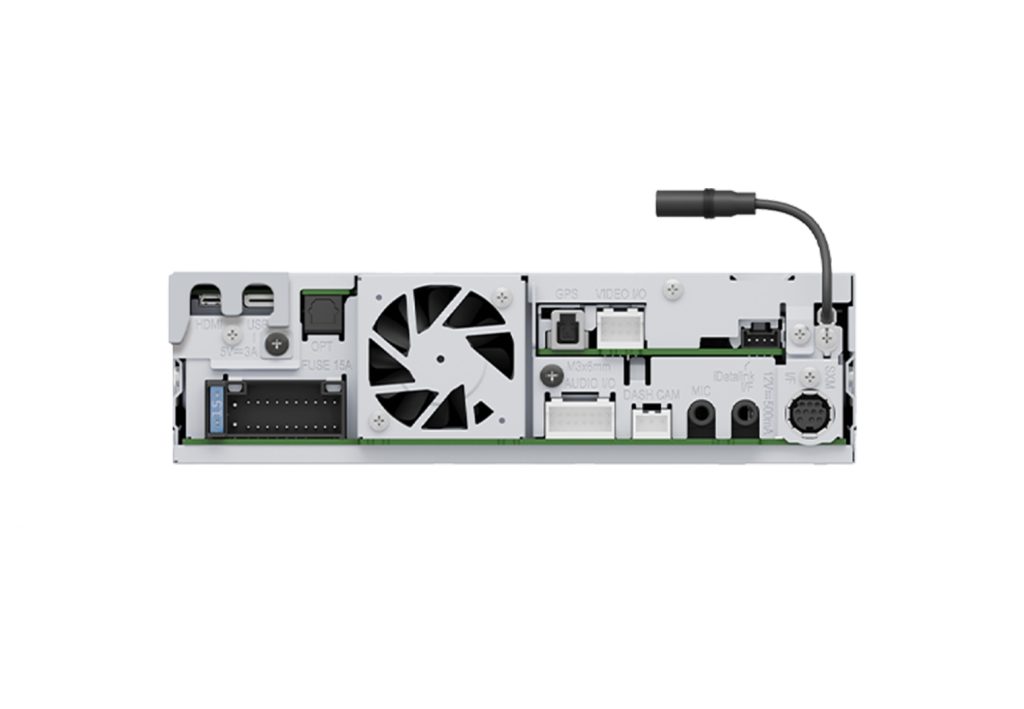
It's a serious source unit too. Kenwood specifies a bonded 1280 by 720 display, wireless CarPlay and Android Auto, LDAC, three pairs of 5V outputs, an optical output, graphic and parametric EQ, time alignment, and two-way or three-way crossovers. Four camera inputs, HDMI, and HD Radio handle expansion. I haven't installed this exact platform, so I'm treating those capabilities as manufacturer-verified rather than hands-on findings.
Fitment is the whole decision. This isn't a universal radio that drops into any double-DIN opening, and at around $1,450 that distinction gets expensive. A compatible APX vehicle kit, the Maestro module, a receiver harness, and careful screen placement are all part of what you're buying. It doesn't ship as a normal stand-alone wiring package, and a two-year warranty doesn't soften the installed total. If your vehicle is supported and keeping factory behavior is the first priority, this is the most complete integration-first option here. If it isn't supported, buy a conventional Maestro-ready receiver instead and don't look back.
| Make | Kenwood |
| Model | Excelon Reference DAX1050XR |
| Head Unit Size | Separate 1-DIN chassis with floating display |
| Screen Size | 10.1 in optically bonded capacitive |
| Display Resolution | 1280 x 720 |
| Smartphone Integration | Wired/wireless Apple CarPlay and Android Auto |
| Preamp Voltage | 5V, front/rear/sub; optical digital output |
| Power Output | 50W x 4 max; no comparable CTA RMS figure published |
| Audio Tuning | 13-band graphic EQ, 14-point parametric EQ, time alignment, 2-way/3-way crossovers |
| Camera Inputs | 4, with HD front/rear support |
| Factory Integration | Maestro RR/RR2 and APX Direct Replacement, vehicle dependent |
| Media / Expansion | Micro-HDMI, USB-C, HD Radio, LDAC, SiriusXM 360L-ready |
| Warranty | 2 years |
| Typical Price | Around $1,450 |
Reasons to buy
- APX Direct Replacement path is purpose-built for supported integrated dashes.
- Separate chassis mounts horizontally or vertically, away from the screen.
- 5V analog and optical digital outputs support advanced amplifier and DSP builds.
- Graphic plus parametric tuning is deeper than most multimedia receivers.
- Four cameras, HDMI, HD Radio, and factory-data display for real expansion.
Reasons not to buy
- A compatible APX vehicle kit and Maestro hardware are mandatory, not extras.
- Installed cost climbs well past the roughly $1,450 receiver price.
- The large screen can block vents or controls if the kit positions it poorly.
- A poor choice for a straightforward universal double-DIN replacement.
Kenwood Excelon KMM-X705
single-DIN digital-media receiver · 5V preouts · 13-band EQ · HD Radio
CarAudioNow may earn a commission from retailer links. Brands do not influence the recommendations.
Why I picked it
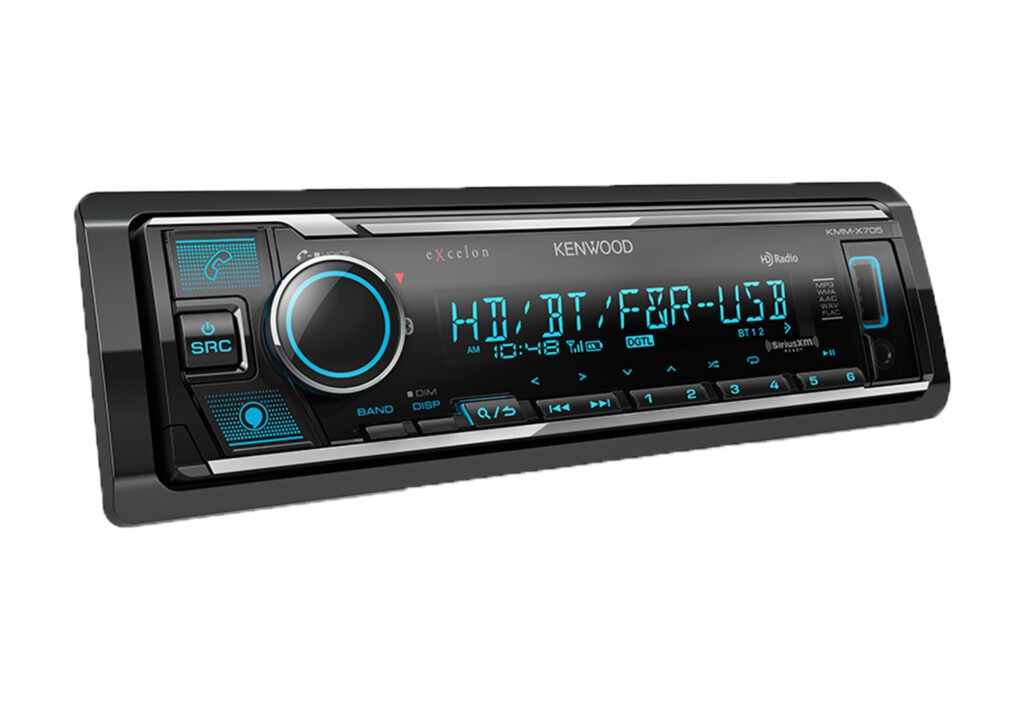
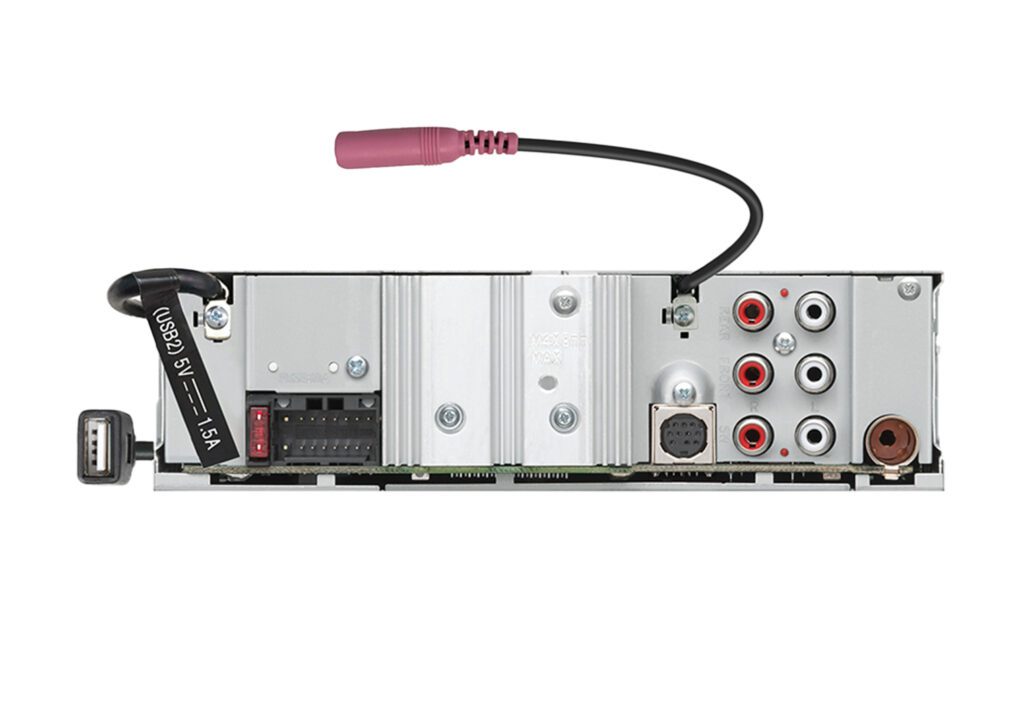
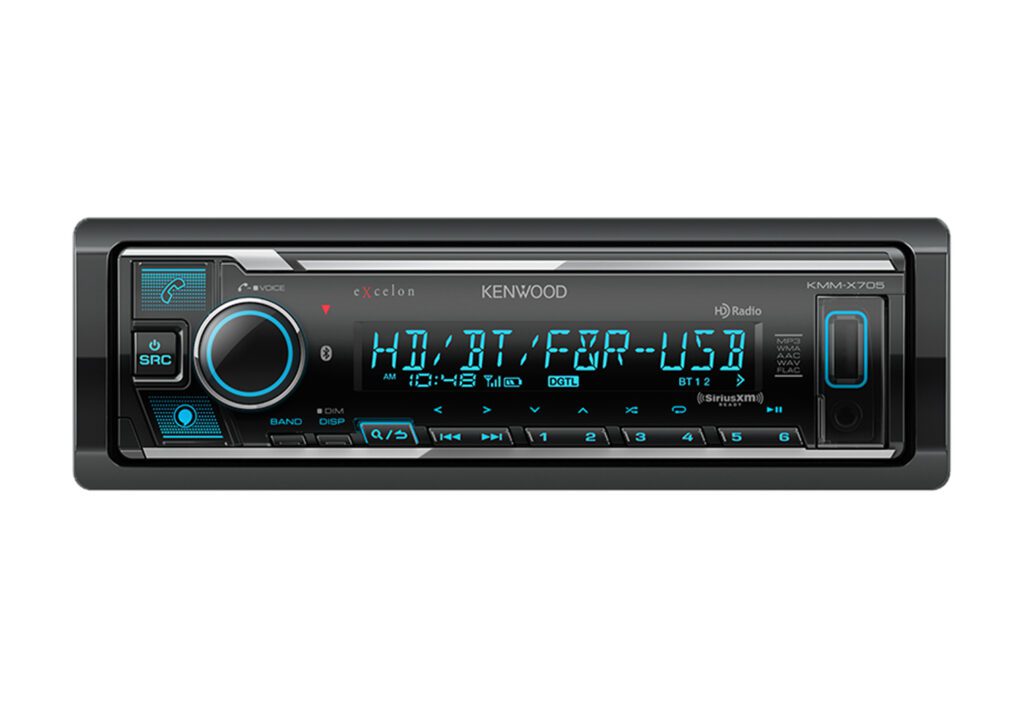
I picked the Excelon KMM-X705 for drivers who want a conventional single-DIN receiver and no touchscreen at all. It's got a detachable face, a rotary volume knob, built-in HD Radio, Bluetooth, and dual USB inputs. Kenwood lists the chassis at 3 15/16 inches deep, though the rear connections and harness need clearance beyond that. In an older dash, where a floating screen would look tacked-on, block controls, or just cost money you didn't need to spend, that's exactly right.
The audio section is what separates it from a basic Bluetooth deck. Three pairs of 5V preamp outputs feed front, rear, and subwoofer amplifiers a strong signal. You also get a 13-band EQ, digital time alignment, crossovers, Stage EQ, and Drive EQ. That's far more control than most screenless receivers bother with. It also plays FLAC up to 24-bit/96 kHz from USB, and the internal amp is rated 22 watts RMS per channel at under one percent distortion.
I've researched and vetted this one rather than installed it myself. It's around $200 with a two-year warranty through an authorized Kenwood retailer. There's no CarPlay, no Android Auto, and no camera display, and Bluetooth 4.2 with 1.5-amp USB charging feels long in the tooth next to a current touchscreen. The 1.5-line text display limits browsing and metadata, and the mechless chassis means no CD slot. For a single-DIN system where sound control and a knob you can find without looking matter more than apps, it's still the deck I'd build around.
| Make | Kenwood |
| Model | Excelon KMM-X705 |
| Head Unit Size | Single-DIN, mechless; 3 15/16-in nominal depth plus rear-connection clearance |
| Screen Size | 0 in; 255-segment, 1.5-line text display only |
| Smartphone Integration | Bluetooth and USB; no CarPlay or Android Auto |
| Preamp Voltage | 5V, front/rear/sub |
| Power Output | 22W RMS x 4 at less than 1% THD |
| Audio Tuning | 13-band EQ, digital time alignment, crossovers, Stage EQ, Drive EQ |
| Camera Inputs | None |
| Factory Integration | Steering-wheel controls through a compatible adapter; no Maestro display integration |
| Media / Expansion | Dual USB, HD Radio, SiriusXM-ready, 24-bit/96 kHz FLAC, Bluetooth 4.2 |
| Warranty | 2 years |
| Typical Price | Around $200 |
Reasons to buy
- Three 5V preout pairs feed front, rear, and subwoofer amplifiers a strong signal.
- 13-band EQ, time alignment, crossovers, Stage EQ, and Drive EQ on a screenless deck.
- Detachable face and a rotary knob you can work without looking down.
- Nominal 3 15/16-inch chassis depth is compact for a full-featured single-DIN.
- HD Radio, 24-bit/96 kHz FLAC, and a two-year warranty at around $200.
Reasons not to buy
- No CarPlay, Android Auto, navigation, or camera display of any kind.
- Bluetooth 4.2 and 1.5-amp USB charging are dated by current standards.
- Mechless design means no CD transport.
- The 1.5-line display makes browsing a long library tedious.
Sony XAV-9000ES
6.75-inch 720p screen · 5V preouts · parametric EQ · Mobile ES
CarAudioNow may earn a commission from retailer links. Brands do not influence the recommendations.
Why I picked it
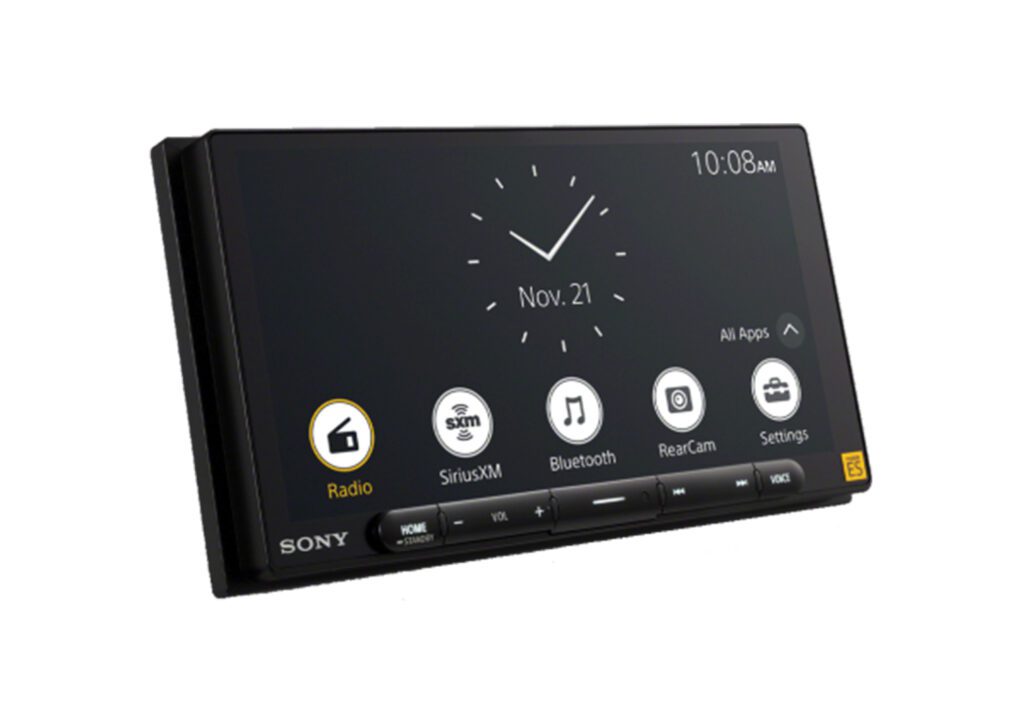
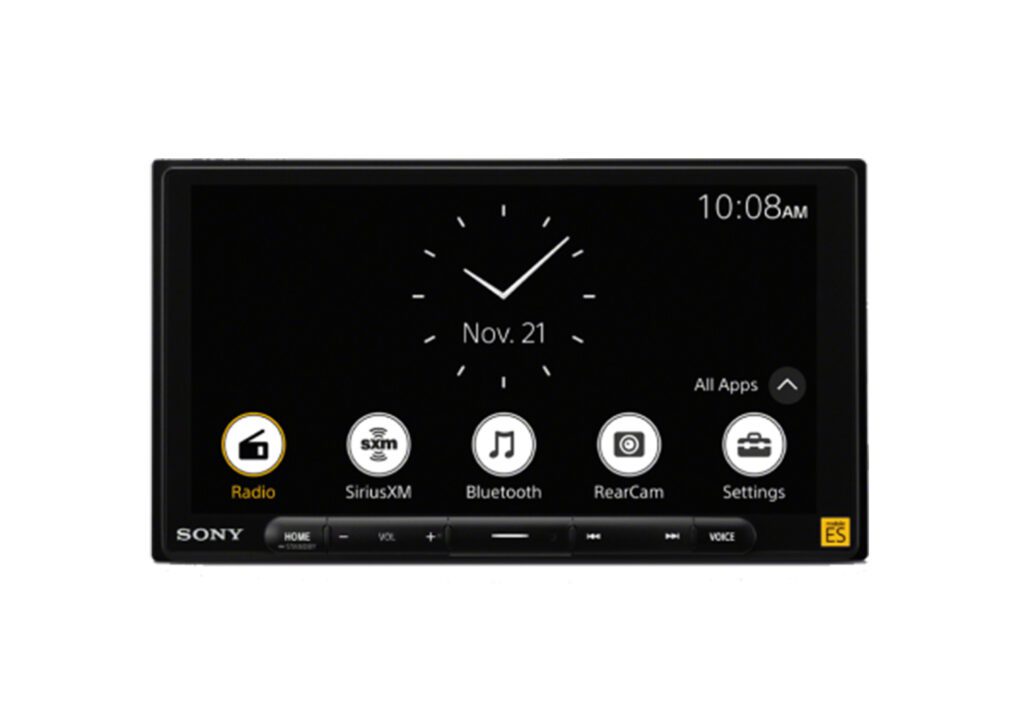
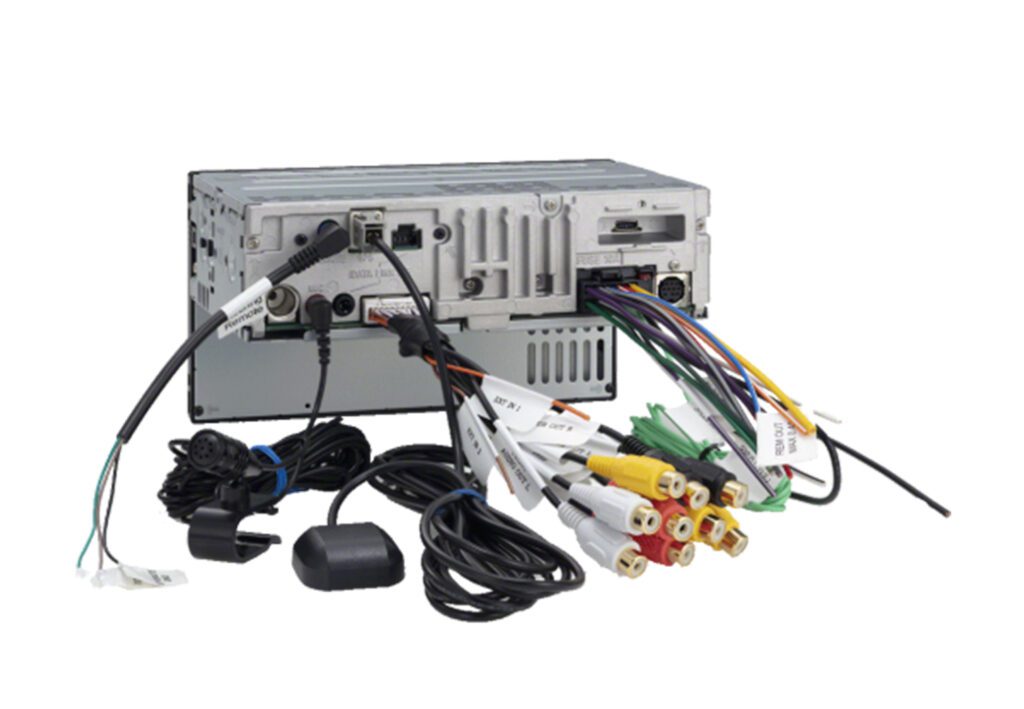
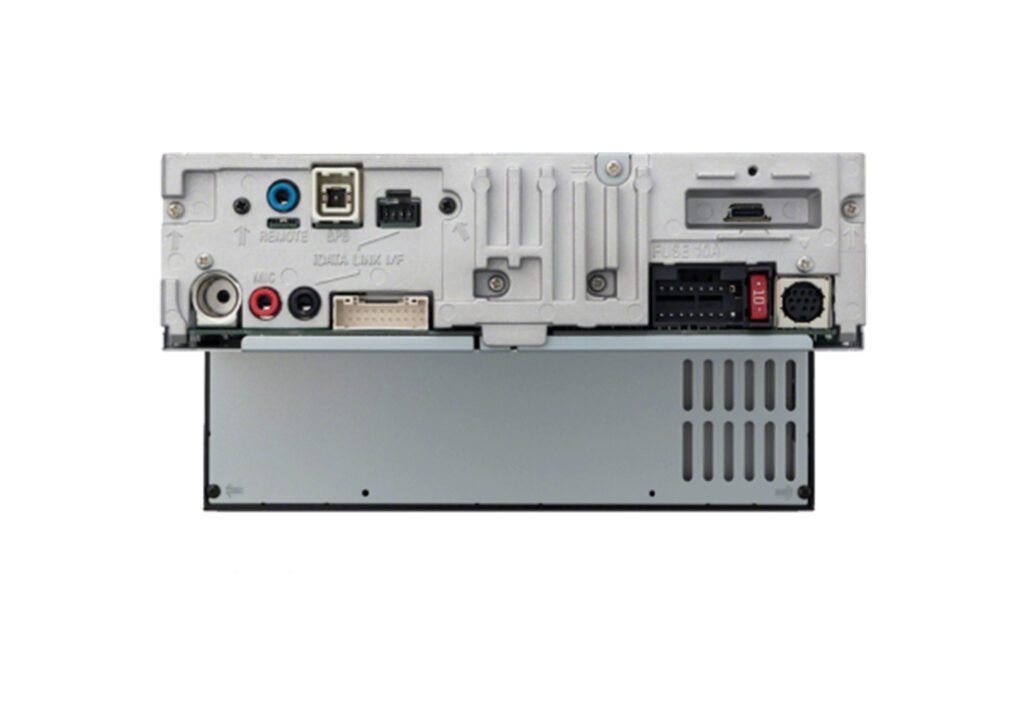
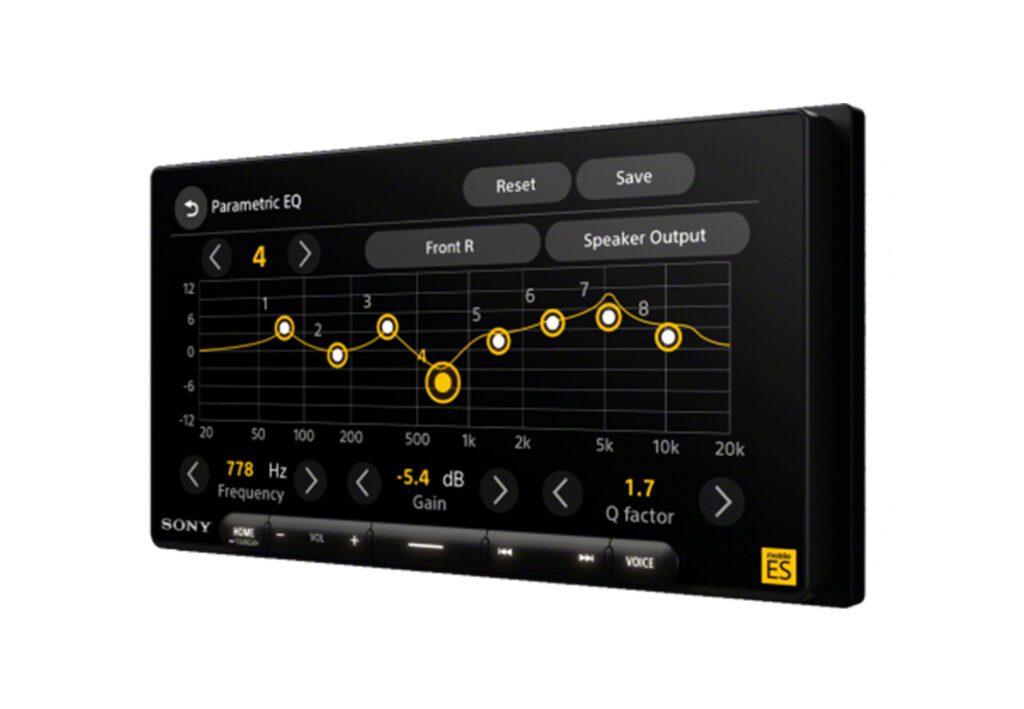
The XAV-9000ES is the fixed-screen receiver I'd choose when sound quality and tuning matter more than HDMI or HD Radio. I unboxed it, powered it on the bench, worked through the interface, played media, and went through the audio controls. What matters isn't the ES badge. It's three pairs of 5V outputs, a 14-band graphic EQ, an eight-band parametric EQ with per-channel control, time alignment, and crossover settings that are unusually deep for a head unit. The parametric section even lets you mute individual outputs while you tune, which is workflow I'd normally expect from a standalone DSP.
Its 6.75-inch capacitive panel is a true 1280 by 720 display, the menus are clean, and USB folder navigation is straightforward. Wireless CarPlay and Android Auto handle daily use, while LDAC and USB open up better sources for a high-resolution library. Three camera inputs add practical flexibility on a truck or an off-road build.
At around $1,000 with a three-year warranty, it's a chunk of change for a fixed 6.75-inch screen, and it leaves out HDMI, an auxiliary input, and HD Radio. That trade is deliberate — this is an audio-first receiver, not the most feature-packed multimedia deck on the shelf. If you're feeding amplifiers, you plan to tune the system properly, and you want a clean OEM-style screen instead of a big floating panel, the 9000ES earns its price.
| Make | Sony |
| Model | XAV-9000ES |
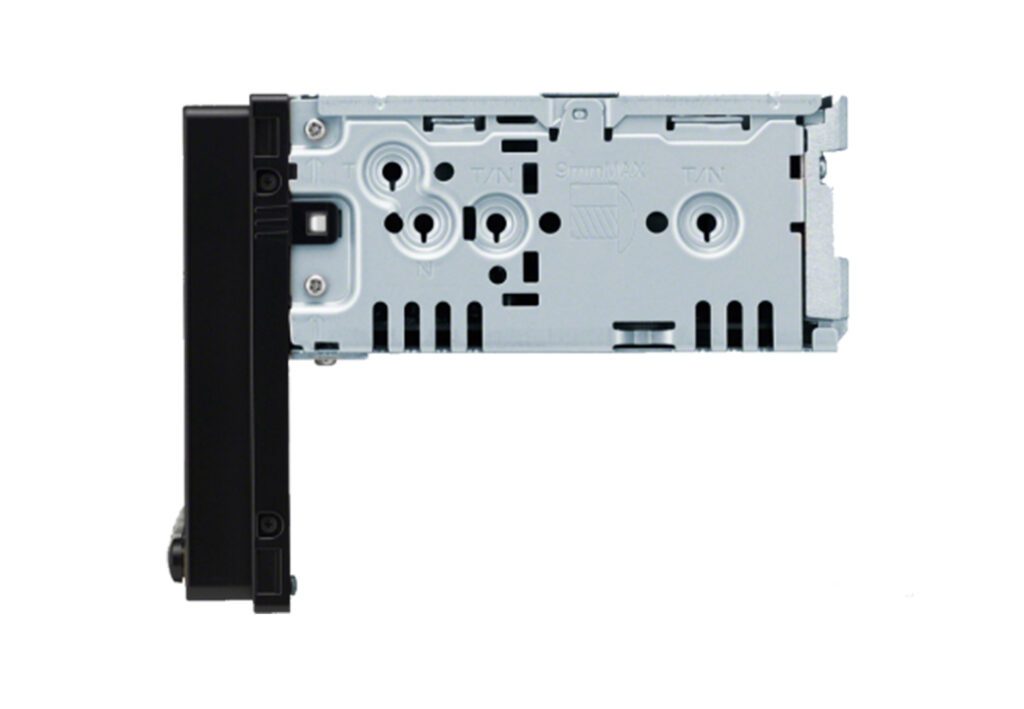
| Head Unit Size | Double-DIN face, shallow chassis |
| Screen Size | 6.75 in capacitive anti-glare |
| Display Resolution | 1280 x 720 |
| Smartphone Integration | Wired/wireless Apple CarPlay and Android Auto |
| Preamp Voltage | 5V, front/rear/sub |
| Power Output | 20W RMS x 4 CTA-2006 |
| Audio Tuning | 14-band graphic EQ, 8-band parametric EQ, time alignment, crossovers |
| Camera Inputs | 3 |
| Factory Integration | Maestro RR/RR2 ready, vehicle dependent |
| Media / Expansion | USB-C, LDAC, FLAC/ALAC/DSD, SiriusXM-ready; no HDMI |
| Warranty | 3 years |
| Typical Price | Around $1,000 |
Reasons to buy
- Bench-tested 14-band graphic and per-channel parametric tuning.
- Three pairs of 5V outputs suit a serious amplifier or DSP path.
- Sharp 1280 x 720 anti-glare capacitive display.
- Three camera inputs with configurable triggers.
- Three-year Mobile ES warranty.
Reasons not to buy
- No HDMI and no analog A/V input.
- No built-in HD Radio.
- Around $1,000 for a conventional 6.75-inch screen.
- The deep tuning controls take time and skill to get right.
JVC KW-M795BW
6.92-inch 720p screen · HDMI · HD camera · wireless CarPlay/AA
CarAudioNow may earn a commission from retailer links. Brands do not influence the recommendations.
Why I picked it
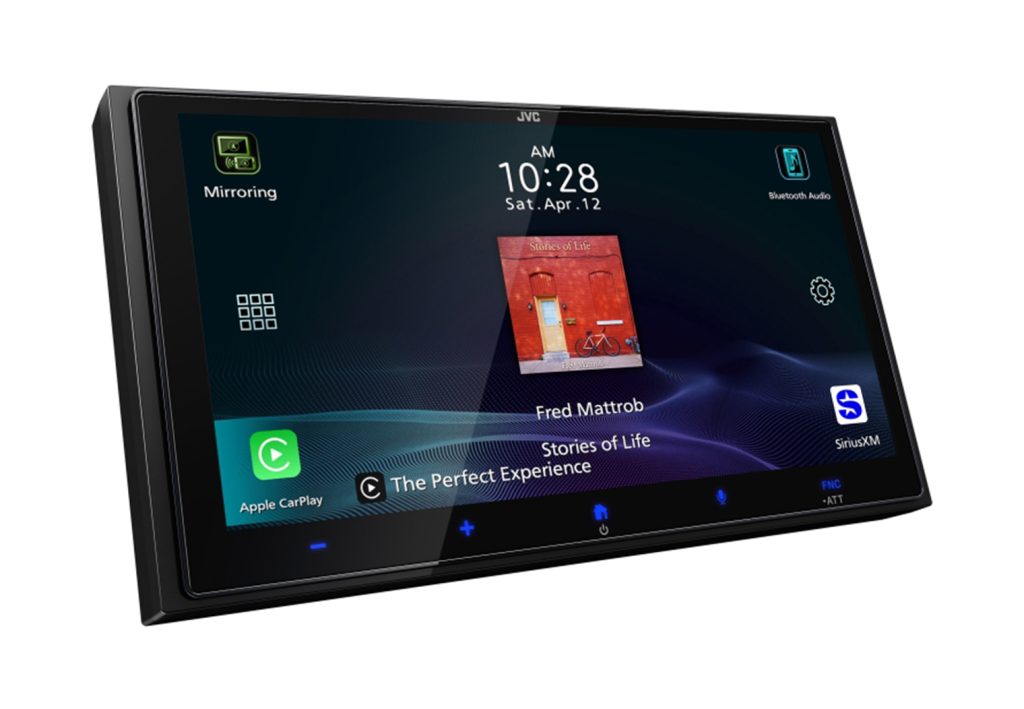
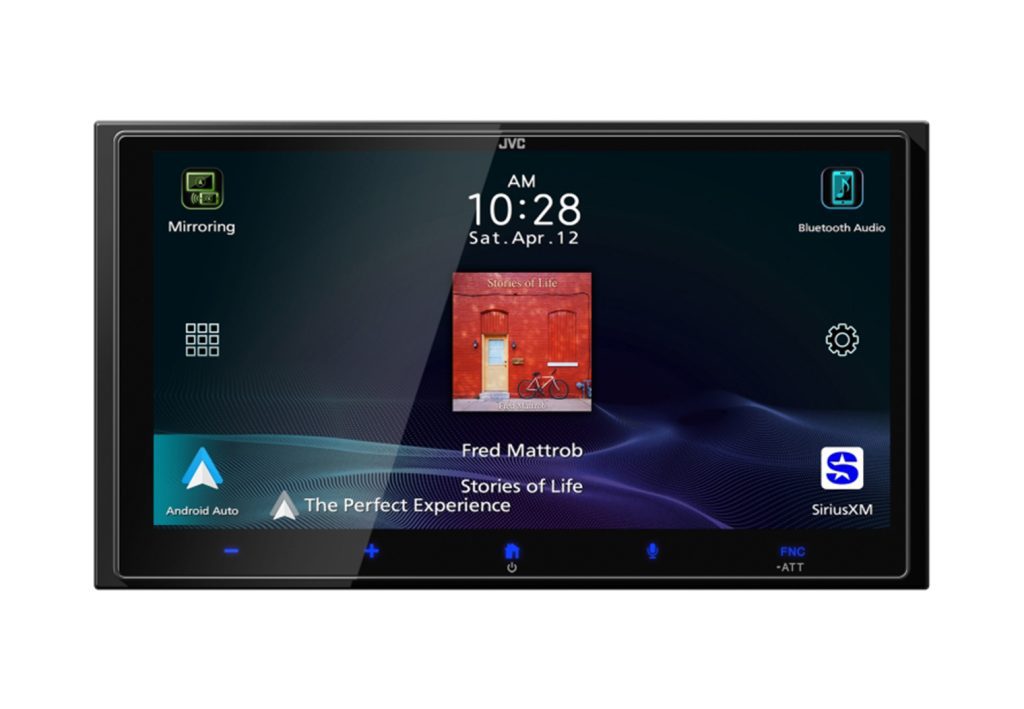
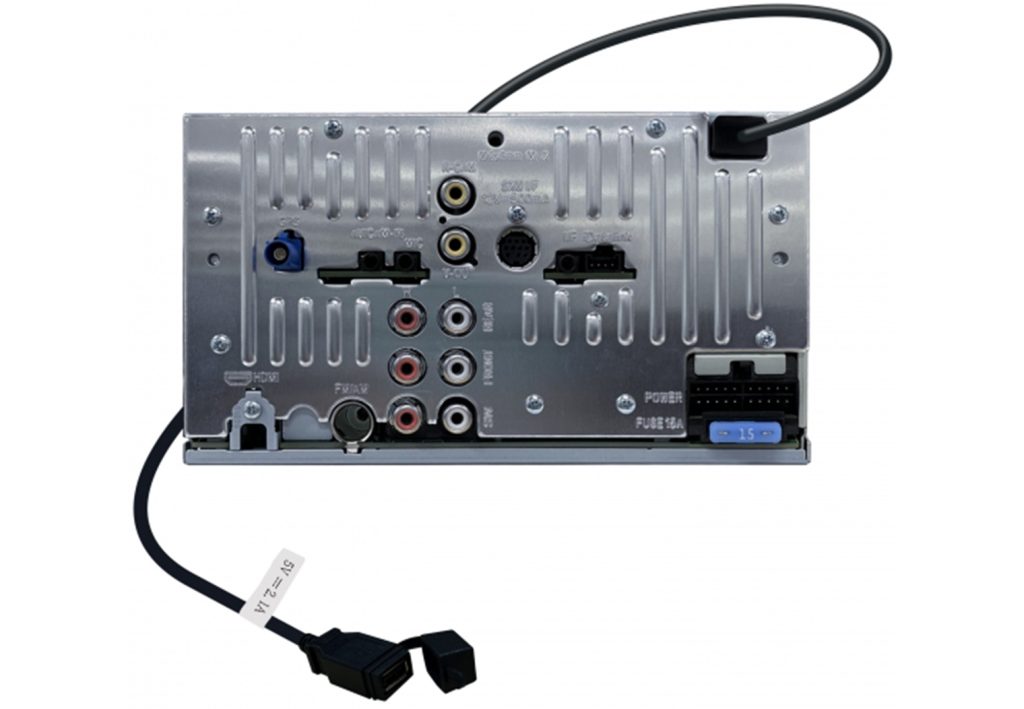
I picked the KW-M795BW because it puts the screen features that actually improve video into a conventional double-DIN receiver at around $500. The 6.92-inch panel is a native 1280 by 720 capacitive display with anti-glare and anti-fingerprint treatment — not another 800 by 480 screen wearing an “HD” sticker. It takes an HDMI source and a compatible 720p rear camera, plus a second switchable A/V or camera input. That makes it a fresher recommendation than the older disc-based Pioneer AVH-W4500NEX.
Daily phone integration is current too. CarPlay and Android Auto run wired or wireless, Bluetooth is 5.3, and Maestro RR/RR2 covers compatible vehicles. The audio section has three pairs of 3V outputs, a 13-band EQ, time alignment, and a three-way crossover. JVC also pushed firmware in May 2026, which tells me more about how this deck will age than a new model number with no support history behind it.
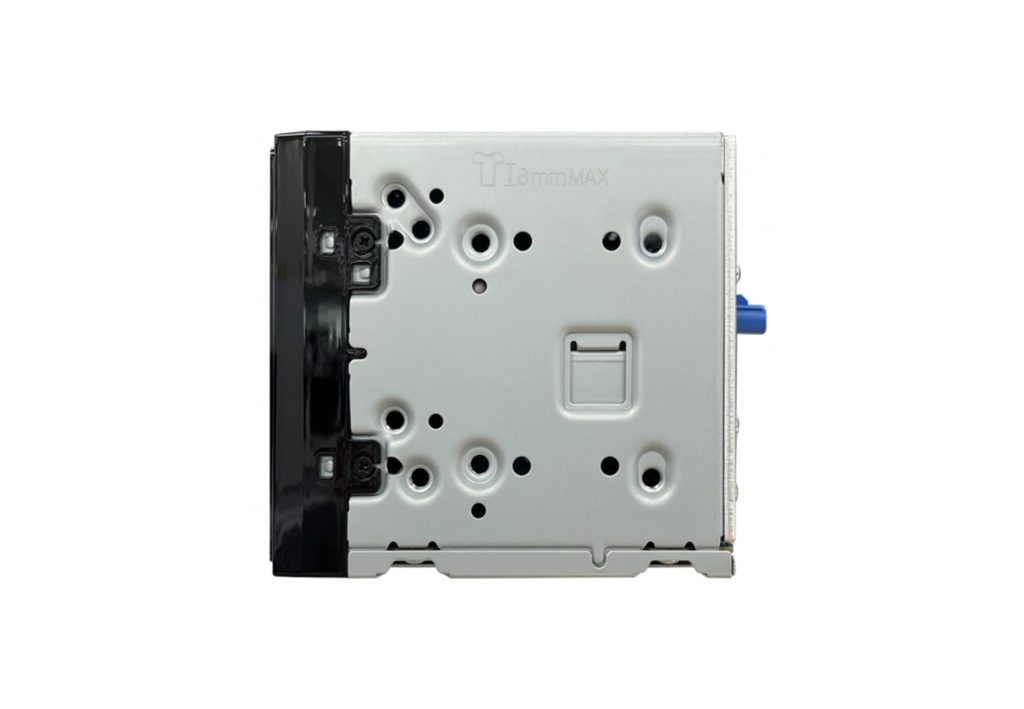
I haven't installed or bench-tested this receiver, and its owner-review history is still short. There's no built-in HD Radio, no physical volume control, and the 4 5/16-inch chassis is shorter than the old disc decks without being genuinely shallow. The two-year U.S. warranty and roughly $500 price help offset that. If you want a sharp fixed screen for CarPlay maps, HDMI video while parked, or a proper HD backup camera, the display hardware here is unusually good for the money.
| Make | JVC |
| Model | KW-M795BW |
| Head Unit Size | Double-DIN, 4 5/16-in chassis depth |
| Screen Size | 6.92 in capacitive anti-glare/anti-fingerprint |
| Display Resolution | 1280 x 720 |
| Smartphone Integration | Wired/wireless Apple CarPlay and Android Auto |
| Preamp Voltage | 3V, front/rear/sub |
| Power Output | 22W x 4 full bandwidth at less than 10% THD |
| Audio Tuning | 13-band EQ, time alignment, 3-way crossover |
| Camera Inputs | 2 paths; HD rear plus switchable A/V/camera input |
| Factory Integration | Maestro RR/RR2 ready, vehicle dependent |
| Media / Expansion | HDMI, USB, Bluetooth 5.3, SiriusXM-ready; no HD Radio |
| Warranty | 2 years U.S. through an authorized seller |
| Typical Price | Around $500 |
Reasons to buy
- Native 1280 x 720 panel at a midrange price, not an upscaled 800 x 480.
- HDMI input and a compatible 720p rear camera make the screen hardware count.
- Wireless CarPlay and Android Auto with Bluetooth 5.3.
- Maestro RR/RR2, three-way crossover, and three preout pairs for later upgrades.
- Two-year warranty plus a 2026 firmware update behind it.
Reasons not to buy
- No built-in HD Radio.
- 3V outputs trail the 5V premium receivers on a larger amp system.
- No knob or hard-button strip for tactile control.
- Short owner history next to the mature Sony and Kenwood platforms.
Kenwood Excelon Reference DMX958XR
6.75-inch 720p screen · 5V preouts · HDMI · four cameras
CarAudioNow may earn a commission from retailer links. Brands do not influence the recommendations.
Why I picked it
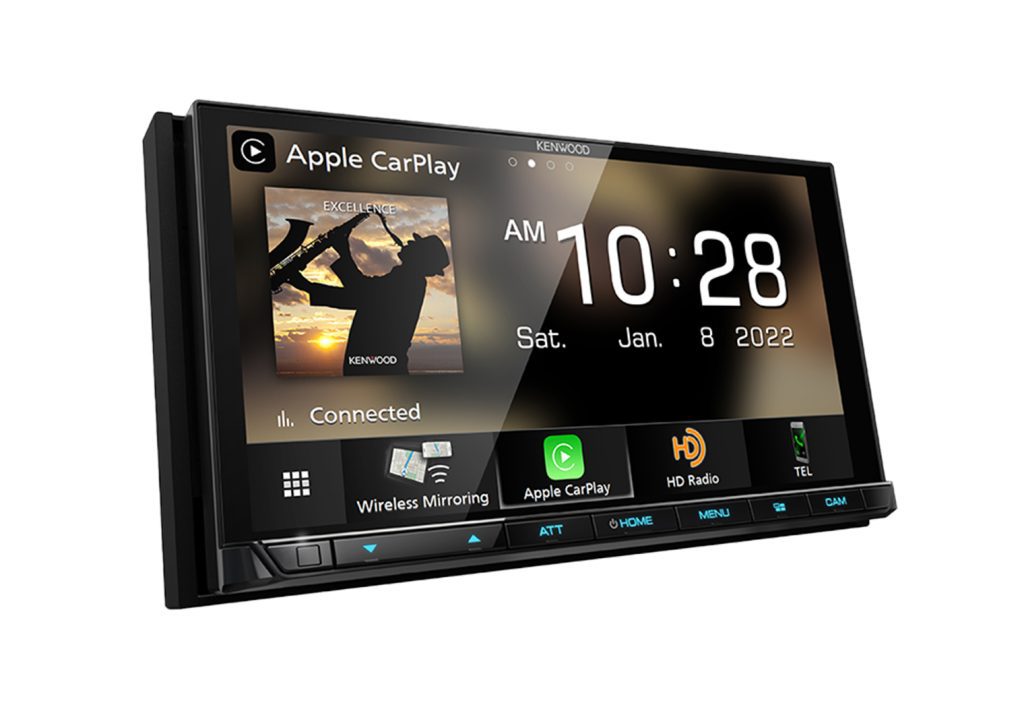
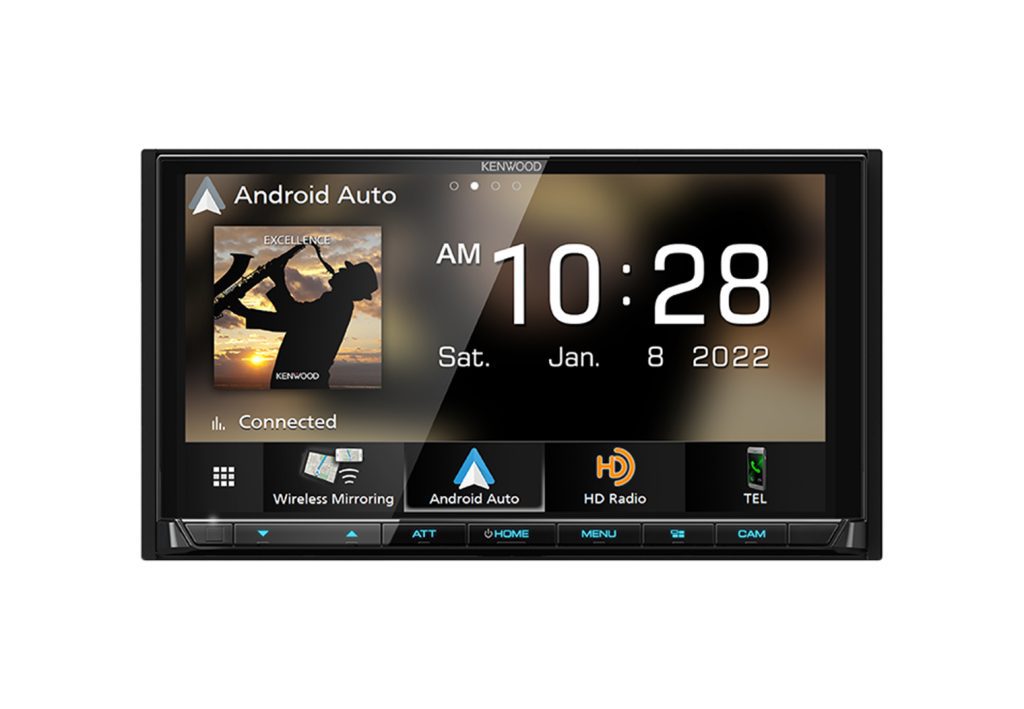
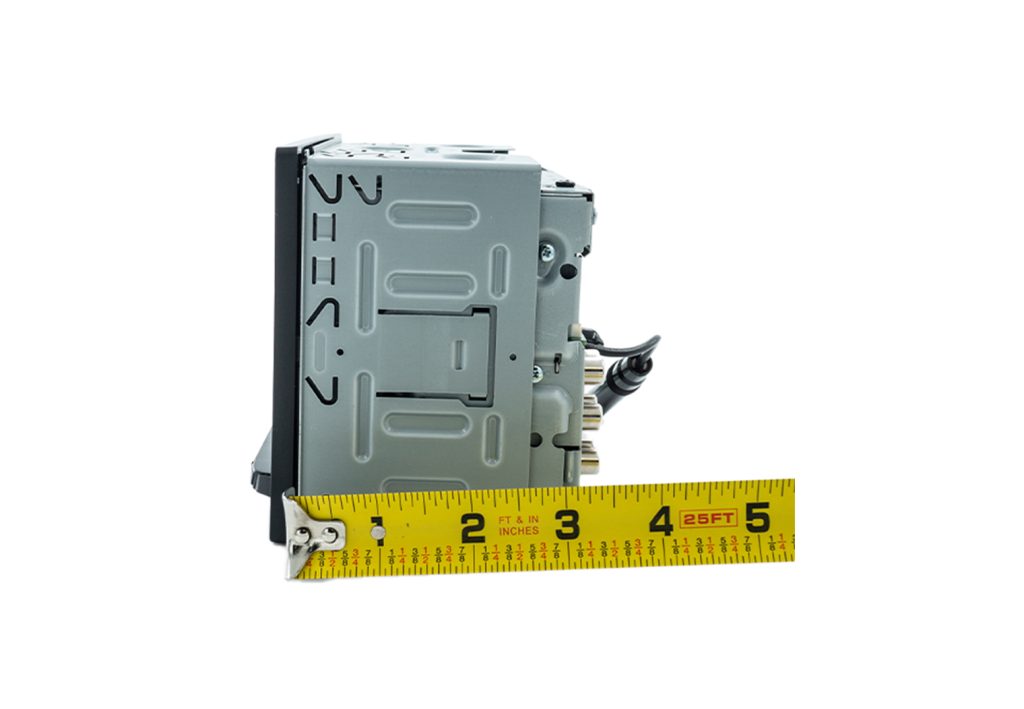
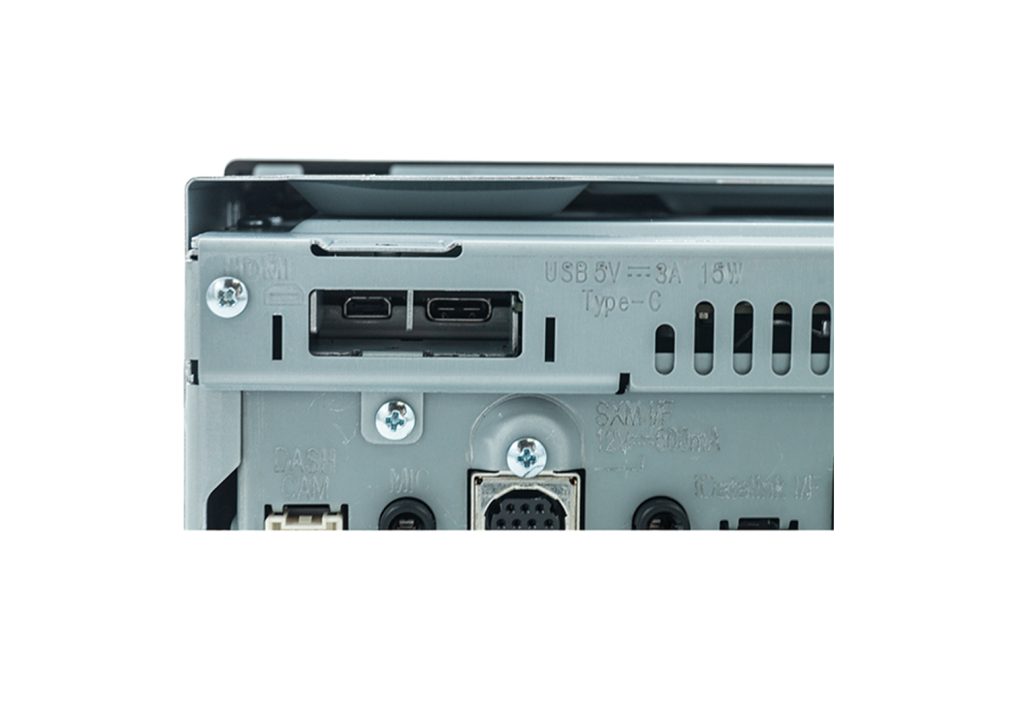
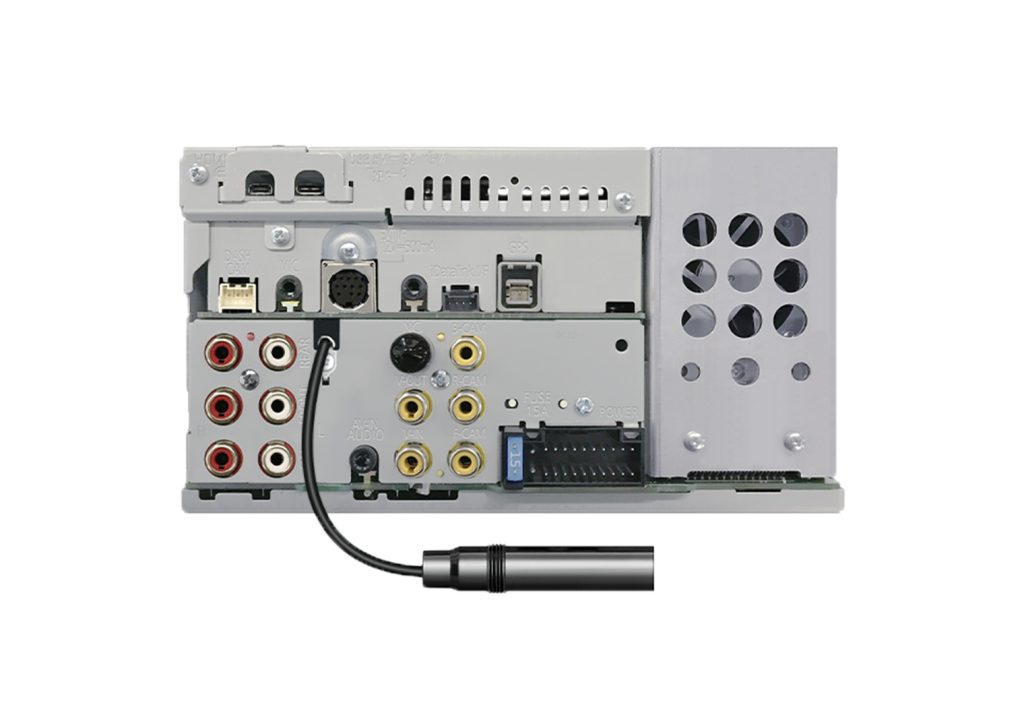
I picked the DMX958XR for the person who wants a premium fixed-screen receiver without losing the inputs an audio-only flagship usually strips out. Its 6.75-inch 1280 by 720 capacitive display drops into a conventional double-DIN opening, and the chassis is only about 4.1 inches deep. Behind it sit three pairs of 5V outputs, micro-HDMI, built-in HD Radio, four camera inputs, SiriusXM support, and Maestro RR/RR2 compatibility. That mix lets one box cover audio, cameras, phone integration, and factory retention instead of three.
The audio side stands on its own. Kenwood specifies 24-bit/192 kHz FLAC and WAV playback, LDAC Bluetooth, a 13-band EQ, time alignment, and both two-way and three-way crossover modes. I haven't installed or bench-tested this one. The recommendation rests on its current specifications, continued firmware support, retail support, and how it stacks up against the Sony 9000ES. The Sony gives you more granular parametric tuning and a longer warranty. The Kenwood gives you HDMI, HD Radio, a fourth camera, and a more complete multimedia path.
The one caution is age. This is a mature platform rather than a fresh launch, even though Kenwood still lists it and pushed firmware in 2025. It's around $1,000 with a two-year warranty. If you want a flush install and one receiver covering high-resolution audio, cameras, HDMI, radio, and OEM integration, the DMX958XR is unusually complete.
| Make | Kenwood |
| Model | Excelon Reference DMX958XR |
| Head Unit Size | Double-DIN, short chassis |
| Screen Size | 6.75 in capacitive |
| Display Resolution | 1280 x 720 |
| Smartphone Integration | Wired/wireless Apple CarPlay and Android Auto |
| Preamp Voltage | 5V, front/rear/sub |
| Power Output | 22W RMS x 4 |
| Audio Tuning | 13-band EQ, time alignment, 2-way/3-way crossovers |
| Camera Inputs | 4, with HD rear-camera support |
| Factory Integration | Maestro RR/RR2 ready, vehicle dependent |
| Media / Expansion | Micro-HDMI, HD Radio, USB-C, LDAC, SiriusXM-ready |
| Warranty | 2 years |
| Typical Price | Around $1,000 |
Reasons to buy
- Fixed 720p display keeps a clean, flush double-DIN look.
- Three 5V output pairs and a three-way crossover mode for an amplified system.
- Four camera inputs, more than most fixed-screen competitors offer.
- HDMI and built-in HD Radio fill two common Sony omissions.
- Two-year Excelon warranty with current retail support.
Reasons not to buy
- A mature platform running an older interface generation.
- No published per-channel parametric EQ like the Sony 9000ES.
- Premium money for a 6.75-inch fixed screen.
- Manufacturer and retailer HDMI-resolution claims conflict — trust Kenwood's published 720p limit.
What is the best double-DIN head unit?
The Kenwood DMX958XR is my best fully equipped conventional double-DIN receiver. Its fixed 720p screen, 5V outputs, HDMI, HD Radio, four camera inputs, and Maestro support cover more complete systems than most flush-screen models. The Sony XAV-AX6000 is the simpler everyday alternative with a shallower chassis, while the XAV-9000ES puts deeper audio tuning ahead of multimedia inputs. If the cavity is unusually tight, the Alpine iLX-W770-M is the easier package.
Fixed, shallow, and floating are different fitment decisions
A fixed double-DIN receiver keeps the screen flush with the dash. A shallow or L-shaped chassis creates more rear wiring space. A floating receiver puts a large screen in front of a smaller chassis. That solves one size limit and hands you a new clearance problem in front of the dash.
Don't assume a compact chassis means a model fits every car. The screen, the mount, the dash kit, the controls next to it, and the integrated factory panel all still get a vote.
The specs that matter most
I compare display resolution and glare before raw inches, then control placement, chassis depth, cameras, factory integration, and the audio outputs the system needs. At this level, the differences worth paying for are a better panel, stronger preouts, deeper tuning, useful expansion, and an install that does not compromise the dash.
Plan the wiring and test every retained feature
A car stereo can take about 30 minutes in a simple older dash, or four to five hours once you're into trim removal, data interfaces, factory amplifiers, microphones, GPS antennas, cameras, USB retention, and tuning. It's worth knowing which one you're signing up for. Read my full car stereo installation guide before deciding whether this is a driveway project.
Use the vehicle-specific harness whenever one exists. Match functions, not just wire colors — colors lie often enough to cost you a morning. My aftermarket radio wire-color guide explains the common convention, while these three wiring methods cover proper connection options.
Before reinstalling trim, test radio reception, wired and wireless phone connections, every speaker, fade and balance, the factory amplifier, steering controls, chimes, USB ports, cameras, reverse trigger, illumination, microphone, and vehicle settings. Confirm the screen clears the shifter and climate controls in every position.
Once it's in, set your crossovers before you turn the volume up, then match amplifier gain and tune from a neutral starting point. The amplifier tuning guide covers the next step.
Car stereo installations and hands-on reviews
Fitment advice lands better when you can see the dash apart. My 2013-2018 Toyota RAV4 upgrade, 2012-2021 Toyota Tundra installation, and 2002-2008 Ram 1500 double-DIN installation show how the kit, harness, cavity, and factory equipment change the job. The general double-DIN walkthrough covers the shared process.
For product-level detail, start with my XAV-AX4000 versus XAV-AX6000 bench comparison, XAV-9000ES bench review, and XAV-9500ES review. If the finished system develops noise, a dead channel, pairing trouble, or memory problems, use the common car stereo problems guide.
Make sure the stereo and install parts fit your vehicle
Start with your exact year, make, model, trim, and factory audio package. Check the radio opening, retained features, dash kit, wiring interface, and camera/USB adapters before ordering. You can also check your dashboard size.
Car stereo questions, answered
What is the best car stereo for most people in 2026?+
The Sony XAV-AX6000 is my best overall pick for most people. It combines a responsive 6.95-inch capacitive screen, wired and wireless CarPlay/Android Auto, three pairs of 5V outputs, useful tuning, HDMI, a shallow chassis, and a three-year warranty. I bench-tested its interface and wireless CarPlay beside the AX4000.
How do I know whether an aftermarket stereo fits my car?+
Check physical fit and retained functions for the exact trim and factory audio package. Use the Vehicle Fit Guide and dashboard-size finder, then confirm the kit, harness, antenna, amplifier interface, cameras, USB adapters, and screen clearance.
What is the difference between single-DIN and double-DIN?+
Single-DIN is the shorter radio opening. Double-DIN is roughly twice the height and usually fits a fixed touchscreen. A floating screen can attach to a compact chassis, but the panel still needs clear space in front of the dash. See the single-DIN guide for that field.
Is wireless Apple CarPlay or Android Auto worth the extra cost?+
Yes if you use phone maps or music most days. Automatic connection removes a small annoyance every drive, while a wired fallback adds stability and charging. If the factory radio already has wired CarPlay, a wireless adapter may be the better upgrade.
Which car stereos still have physical buttons or a volume knob?+
The conventional Kenwood KMM-X705 has a rotary control and detachable button-based face. The Sony XAV-AX6000 has a useful lower hard-key strip. Many current full-screen receivers rely more heavily on touch and steering-wheel controls.
Can I keep steering-wheel controls, the factory amplifier, cameras, and vehicle settings?+
Often, but only with the correct receiver, interface, and firmware for the exact vehicle. My iDatalink Maestro explainer shows what the interface can do.
How much should I budget beyond the radio?+
Budget for the dash kit, harness or data interface, antenna adapter, USB and camera retention, microphone or GPS routing, and labor. A late-model amplified vehicle can add several hundred dollars in integration hardware before labor.
Do 5V preouts and more EQ bands automatically make a stereo sound better?+
No. Higher preamp voltage can help the amplifier signal path resist noise, and more EQ bands provide finer control. Neither fixes weak speakers, poor mounting, clipping, bad gain settings, or an untreated door.
Are cheap Android head units worth buying?+
Sometimes, but only with a strong return policy, confirmed vehicle support, and realistic expectations about firmware and output quality. A simpler major-brand receiver usually provides clearer specifications, support, and a known adapter ecosystem.
Should I replace the factory stereo or add a wireless adapter?+
Keep the factory stereo when it is stable, retains important functions, and already has wired CarPlay or Android Auto. Replace it when you need a better interface, audio outputs, tuning, cameras, integration, or features the factory hardware cannot add cleanly.
Why trust this guide?

More receiver and fitment guides
Use the specialist guide when one format or integration path is already decided.